
At Solid Rock Baptist Church in Berlin, New Jersey, the campus stays busy well beyond Sunday services. Its buildings also serve a K–12 Christian school, a gymnasium, and programs that bring people together throughout the week.
Keeping those spaces comfortable and running takes electricity. As energy costs rose, church leadership began exploring how solar could reduce operating expenses and leave more room in the budget for the people and programs they support.
In 2025, that planning became a working rooftop solar installation.
Exact Solar designed and installed a 248.6-kilowatt solar energy system with 452 panels at the church’s Camden County campus. The project required careful coordination around school days, church activities, and the permitting and utility approvals needed for a commercial installation.
For Solid Rock, it was a long-term investment in a property and community they intend to serve for generations.
Here’s how the church evaluated its options, how our team planned the installation, and what other congregations in New Jersey and Pennsylvania can learn from the project.
Table of Contents
Why Solid Rock Baptist Church Decided to Go Solar
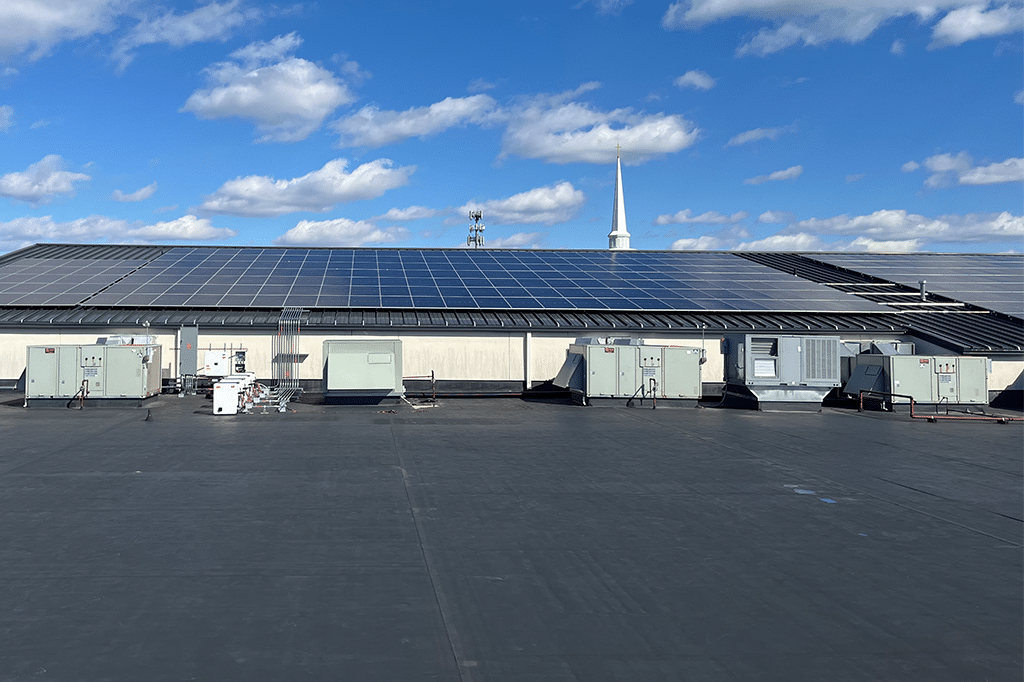
A church that also operates a school has electricity needs throughout the week. Classrooms, offices, and a gymnasium all require lighting, equipment, and comfortable indoor conditions.
Those expenses continue regardless of how donations fluctuate from month to month. For church leadership, reducing an ongoing operating cost can create more flexibility for ministry, education, building upkeep, and community programs.
Solid Rock’s daytime activity also made solar worth exploring. A school uses electricity during many of the same hours that rooftop panels generate it, allowing solar production to serve part of the campus’s daily demand.
In early 2024, Solid Rock’s leadership met with Exact Solar to compare two approaches: purchasing a system or entering a power purchase agreement, commonly called a PPA.
Under a PPA, a third party owns the solar equipment and sells the electricity it generates to the property owner at an agreed rate. This can allow a nonprofit to use solar with little or no upfront investment, depending on the agreement.
Purchasing a system gives the organization ownership of the equipment and access to applicable ownership incentives. That purchase can be paid for upfront or financed.
After reviewing the options, Solid Rock chose ownership. The decision aligned with the church’s long-term plans for its campus and its goal of reducing electricity expenses over time.
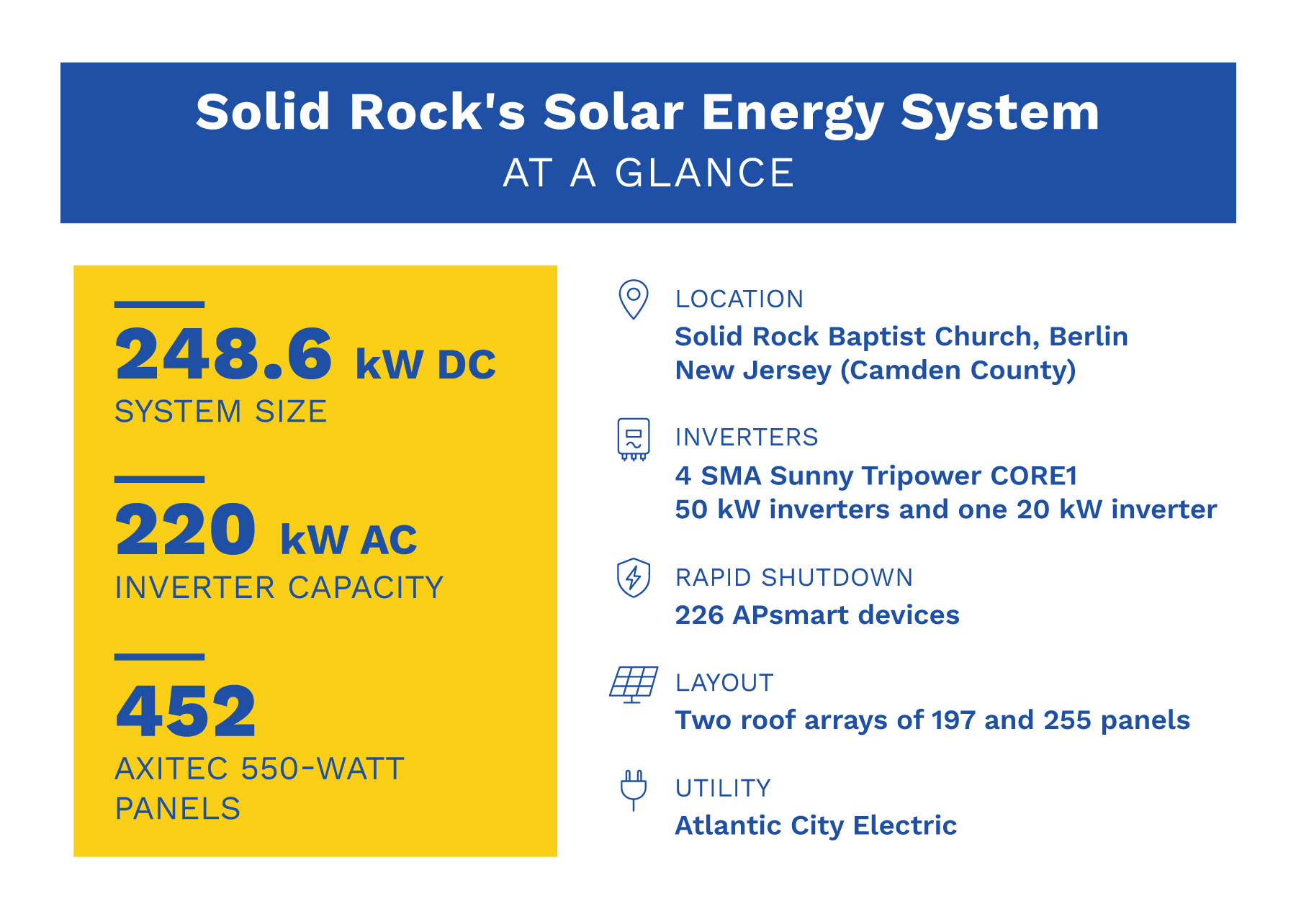
Solid Rock’s Solar Energy System at a Glance
| Project detail | Specification |
|---|---|
| Location | Solid Rock Baptist Church, Berlin, New Jersey |
| County | Camden County |
| Property use | Church and K–12 Christian school |
| System size | 248.6 kW DC / 220 kW AC |
| Solar panels | 452 Axitec 550-watt panels |
| Inverters | Four SMA Sunny Tripower CORE1 50 kW inverters and one 20 kW inverter |
| Rapid-shutdown equipment | 226 APsmart devices |
| Array layout | Two rooftop arrays with 197 and 255 panels |
| Electric utility | Atlantic City Electric |
| Ownership approach | Church-owned system |
| Operational milestone | Commissioned in spring 2025 |
The two capacity figures describe different parts of the system. DC capacity refers to the combined rated output of the panels. AC capacity refers to the inverters’ rated output after converting solar electricity into the form the building uses.
Designing a Solar Installation Around an Active Church and School
Every solar project starts with the building and the people who use it.
Solid Rock’s broad, unshaded, standing-seam metal roof offered favorable conditions for solar. The more involved challenge was planning construction around a campus that remained active throughout the week.
Students, teachers, church staff, coaches, and visitors needed to continue using the property while installation work moved forward.
Planning Equipment Locations and Site Access
During the initial site visits, Exact Solar worked with church leadership to plan where equipment would go and how installation crews would access the building.
That included reviewing electrical equipment locations, planning conduit routes along the building, and coordinating how materials would be delivered and moved.
These decisions affect more than the appearance of a finished installation. They help organize the work around the property’s daily activities and establish clear expectations before crews arrive.
For a church with an operating school, that coordination is an important part of the project.
Incorporating Rooftop Access and Fire Safety
The panel layout also needed to account for rooftop access and applicable fire-safety requirements.
After an initial review, Exact Solar revised the design in August 2024 to add pathways between panel sections. The final layout includes two rooftop arrays with 197 and 255 panels.
The Borough of Berlin issued the construction permit in August.
Designing a commercial solar installation involves balancing several needs: available roof space, electricity production, equipment placement, maintenance access, and code requirements. At Solid Rock, those considerations shaped the finished system.
Managing Utility Approval and Commissioning
Exact Solar also managed the project’s interconnection process with Atlantic City Electric.
Interconnection is the process through which the utility reviews and approves a solar system’s connection to the electrical grid. It includes applications, technical review, and the steps required before the system can operate in parallel with the utility.
Permission to operate, often shortened to PTO, is the utility’s authorization to operate the interconnected system.
Our in-house team handled the project’s engineering, design, permitting, utility applications, installation, and commissioning. Exact Solar also remains the church’s contact for service and questions about applicable workmanship and equipment warranties.
A Long-Term Investment in the Church’s Mission
Joe Tarzia, the Exact Solar sales engineer who led the project, worked with church leadership to evaluate the financial approach alongside the system design.
“Working with the folks at Solid Rock was one of the most rewarding projects of my career so far. The church leadership was extremely receptive to the idea of solar, and educating them on the many environmental and economic benefits was a pleasure. We helped them put structured financing in place that lowered their electricity spend and is projected to save the church $2.2 million over the next 30 years in costs they would have otherwise paid to their utility!”
– Joe Tarzia, Exact Solar Sales Engineer
The $2.2 million figure is a 30-year projection, rather than savings already realized. Actual results will depend on system performance, future utility prices, electricity use, and the assumptions used in the financial analysis.
For church leadership, the goal was to put a long-term asset to work for the campus. Generating electricity on-site can reduce what the organization purchases from the utility and give it more control over a portion of its operating expenses.
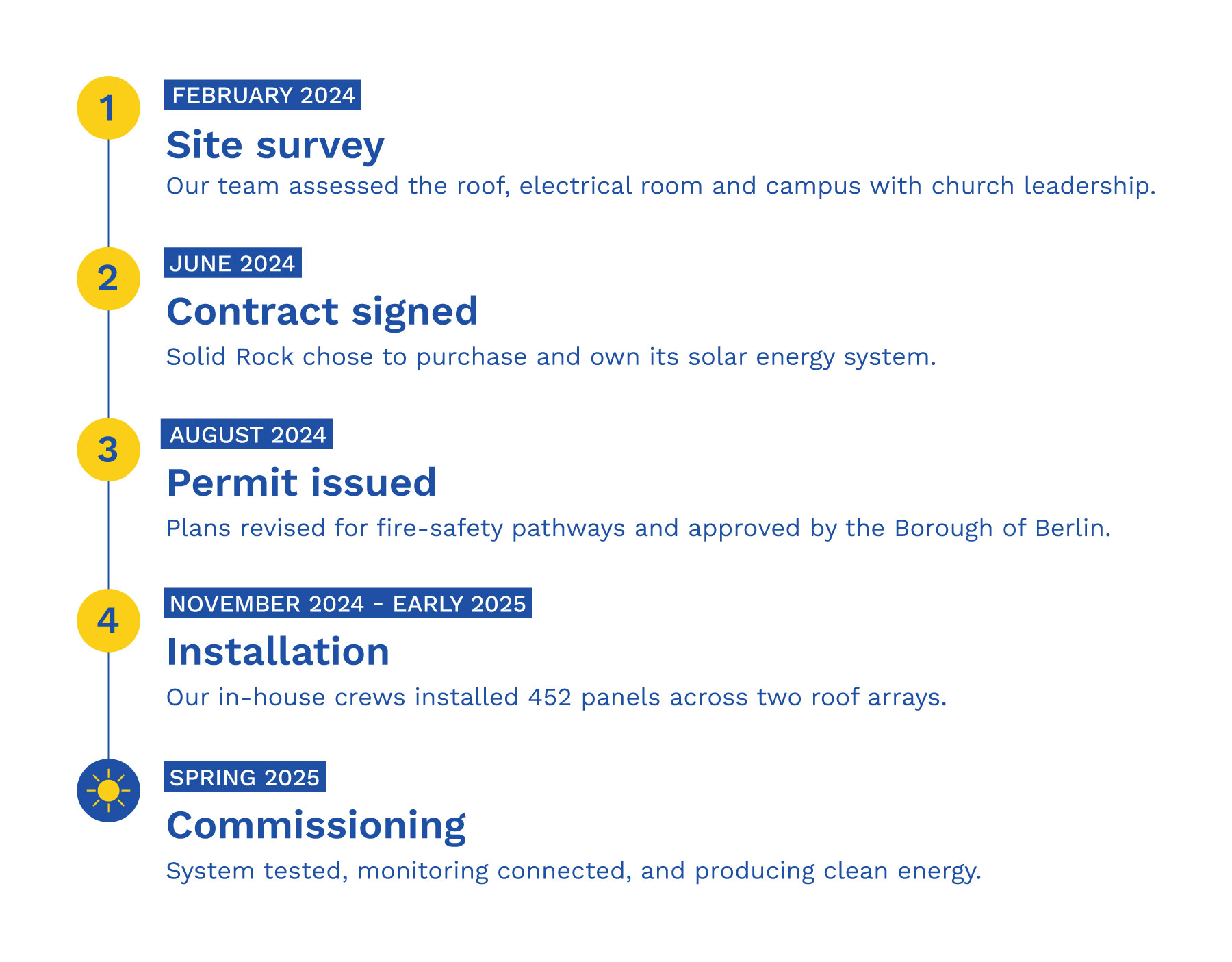
Solid Rock Baptist Church’s Solar Project Timeline
Commercial solar projects involve several stages before installation begins. Engineering, local permits, equipment procurement, utility review, and coordination with building occupants all affect the schedule.
Solid Rock’s project took just over a year from the initial site survey to operation.
| Timing | Milestone |
|---|---|
| February 2024 | Exact Solar surveyed the roof, electrical room, and campus to evaluate the installation and its fit with daily church and school activity. |
| June 2024 | Solid Rock signed its contract after comparing ownership with a PPA. Our engineers then completed the full permit design. |
| August 2024 | Following revisions to the rooftop pathways, the Borough of Berlin approved the plans. The team also began the interconnection process with Atlantic City Electric. |
| November 2024 through early 2025 | Exact Solar’s in-house crews installed the panels, inverters, rapid-shutdown equipment, and electrical connections. |
| Spring 2025 | The team tested the system, connected monitoring equipment, and completed commissioning as the church began producing solar electricity. |
Much of the overall schedule involved preparation and approvals rather than crews working on the roof.
That distinction is useful for other congregations planning a project. A longer development schedule does not mean a church or school will be under construction for that entire period.
Following the installation, Solid Rock introduced Exact Solar to two affiliated New Jersey churches. Several congregation members have also begun considering solar for their homes.
Why Solar Can Be a Good Fit for Churches
Exact Solar has worked with houses of worship throughout our more than 20 years in business. Each congregation has its own financial priorities, building conditions, and plans for the future.
Another example is United Christian Church of Levittown’s solar installation, which offers a look at how a Pennsylvania congregation approached going solar.
Several characteristics can make churches strong candidates for solar.
Large Roofs and Other Available Space
Sanctuaries, fellowship halls, gymnasiums, and school buildings often provide substantial roof space.
When that space has suitable sun exposure and the roof is in good condition, it can support a system that offsets a meaningful portion of the property’s electricity use.
Roof age, structural capacity, shading, and access requirements all need to be evaluated before deciding what is feasible. If roof replacement is approaching, addressing it before solar installation may help avoid removal and reinstallation costs later.
Some churches also have land or parking areas that could support a ground-mounted system or solar carport. Those options require their own review of site conditions, costs, and approvals.
Daytime Electricity Use
Churches with schools, daycares, offices, food pantries, or weekday programs often use electricity during solar production hours.
That overlap can help the building use solar electricity as it is generated.
A church that is quieter during the week may still benefit. Where net metering is available, eligible systems can receive credits for excess electricity sent to the grid, helping offset electricity purchased at other times.
The value of those credits and how they are applied depend on the utility’s rules and the property’s rate schedule. Reviewing actual usage and billing information helps determine the best system size.
More Control Over Operating Expenses
Rising electricity costs have become a significant concern in New Jersey. In January 2026, Governor Mikie Sherrill signed executive orders addressing utility costs and declaring an energy emergency.
For a congregation, the practical concern is how those costs affect its own budget.
Statewide averages cannot tell a church exactly how much it could save. Electricity usage, supplier contracts, utility rates, fixed charges, and demand charges can all influence the bill.
That is why a useful solar proposal starts with the property’s actual electricity costs and explains the assumptions behind its projections.
Solar can reduce exposure to future price increases for the electricity it replaces. The building generally remains connected to the utility, and some charges will continue.
For churches, reducing those purchases can leave more funding available for staff, youth programs, outreach, missions, or building maintenance.
A Visible Commitment to Stewardship
For many congregations, caring for their community includes being thoughtful about the resources they use.
Solar can connect that commitment with an investment in the church’s property. It gives members and neighbors a visible example of how the organization is planning for its future.
At a campus with a school, the installation can also create opportunities to discuss electricity generation, energy use, and environmental responsibility with students.
The reasons for going solar will vary from one congregation to another. A well-planned project should reflect the organization’s priorities and provide benefits its leadership can explain clearly.
How Churches Can Pay for Solar
Churches can consider several approaches, including purchasing with available funds, financing a purchase, or using a third-party ownership arrangement such as a PPA.
The best choice depends on available capital, borrowing terms, incentive eligibility, and the church’s long-term plans.
Purchasing or Financing a Church-Owned System
A church can purchase a system outright or finance the purchase.
Financing a purchase still means the church owns the system, subject to the financing agreement. Loan payments spread the cost over time, while interest and fees affect the total project cost.
For an ownership proposal, leadership should review:
- The total installed price and any required roof or electrical work.
- Financing costs and repayment terms, if applicable.
- Projected electricity production and utility savings.
- Available incentives and when they may be received.
- Maintenance responsibilities and warranty coverage.
- The assumptions behind the projected financial return.
Paying upfront avoids financing costs, but it also uses funds the congregation may need for other priorities. Comparing the options helps leadership evaluate both the long-term value and the effect on its current budget.
Elective Pay for Eligible Tax-Exempt Organizations
Historically, tax-exempt churches could not directly use federal income tax credits in the same way as taxable businesses.
The Inflation Reduction Act introduced elective pay, also called direct pay, allowing eligible tax-exempt organizations to receive the value of certain qualifying clean energy credits as an IRS payment.
A qualifying church-owned solar project may be eligible for a 30% investment credit when the applicable requirements are met. The amount is not automatically 30% for every project.
The organization must establish eligibility, complete IRS pre-filing registration, and file the required return and election. Elective pay is generally claimed after the system is placed in service; it is not an automatic discount applied to the installation invoice.
Read our guide to how tax-exempt entities can claim elective pay for more background.
Why Timing Matters for New Church Solar Projects
Solid Rock’s system began operating in 2025. Churches planning a new project in 2026 or 2027 need to evaluate the rules and deadlines that apply to their own installation.
Federal legislation enacted in July 2025 accelerated the end of solar tax credits for certain projects. Under IRS guidance, solar facilities that begin construction after July 4, 2026, generally must be placed in service by December 31, 2027, to qualify for the Section 48E credit. Projects meeting the earlier construction-start requirements are subject to different timing rules.
Elective pay remains a way for eligible organizations to receive an applicable credit, but it does not remove the underlying credit’s eligibility requirements or deadlines.
A church’s advisor should review the project’s timing, equipment requirements, applicable exceptions, and documentation before the organization relies on an incentive in its financial plan.
For a broader explanation of eligibility and project planning, read our guide to claiming the commercial solar tax credit in 2026.
Power Purchase Agreements
Under a PPA, a third party owns the system and sells the solar electricity it produces to the church at a contracted price per kilowatt-hour.
These arrangements can provide access to solar with little or no upfront cost. The system owner typically claims applicable ownership incentives and handles responsibilities specified in the agreement.
Leadership should review the starting electricity rate, any annual rate increases, the contract term, maintenance obligations, and options if the church sells the property or wants to purchase the system later.
A PPA can be a useful option for a congregation that wants to preserve capital. The financial benefit depends on the agreement and how its costs compare with the electricity purchases it replaces.
Solid Rock evaluated a PPA and chose ownership based on its goals.
New Jersey Solar Production Incentives
Qualifying New Jersey projects can also participate in state solar incentive programs.
The Administratively Determined Incentive program supports eligible residential and smaller nonresidential projects through Solar Renewable Energy Certificates, known as SREC-IIs.
A qualifying system earns one SREC-II for each megawatt-hour, or 1,000 kilowatt-hours, of solar electricity generated. Incentive values depend on the applicable program category and registration terms.
These payments are separate from the savings associated with using solar electricity or receiving utility bill credits.
Program eligibility, registration, and ownership of the certificates should be addressed in the proposal.
You do not need to navigate every program on your own. Exact Solar can help your leadership team understand the available approaches and prepare questions for your accountant or tax advisor.
Is Your Church Ready to Explore Solar?
Solid Rock’s project began with a conversation about its buildings, electricity expenses, and plans for the future.
Your church can start the same way.
A year of electric bills, information about the roof’s age and condition, and a discussion of upcoming building projects can help establish whether solar is worth exploring. From there, our team can evaluate the property and explain the available options.
Joe Tarzia, the commercial sales engineer who led Solid Rock’s project, works with churches, businesses, nonprofits, and municipalities to assess how solar could support their goals.

Joe Tarzia
Commercial Sales Engineer
📞 (267) 623-6729
✉️ [email protected]
If your congregation is in New Jersey or Pennsylvania, we would be happy to learn more about your property and answer your questions.
Get a free solar estimate for your church
Frequently Asked Questions About Solar for Churches
Can Churches Receive the Federal Solar Tax Credit?
Eligible tax-exempt churches can use elective pay to receive the value of an applicable clean energy tax credit as an IRS payment.
The church must own the qualifying system and meet the relevant eligibility, registration, and filing requirements. Credit amounts and deadlines depend on the project. Under a PPA or lease, the third-party owner generally claims applicable ownership incentives instead.
Will Installation Disrupt Services or School Activities?
Some coordination is necessary, particularly for deliveries, work areas, electrical connections, and any planned power interruptions.
At Solid Rock, Exact Solar planned the installation around an operating church and school. Much of the work took place on the roof and around electrical equipment.
The expected disruption depends on the property and scope of work. Our team discusses access needs and coordinates planned interruptions with the organization in advance.
How Large a Solar System Does a Church Need?
The right size depends on electricity usage, available space, shading, electrical infrastructure, utility requirements, and the organization’s goals.
We typically begin with 12 months of electricity bills to understand seasonal demand. We then evaluate how much solar the property can support and what system size makes financial sense.
Solid Rock’s 452-panel installation reflects its campus’s needs. Another church may require a much smaller or larger system.
Should a Church Purchase, Finance, or Use a PPA?
Each approach has different financial implications.
- An upfront purchase avoids loan interest and gives the church ownership, while requiring available capital.
- A financed purchase spreads payments over time while retaining ownership, with interest and other terms affecting the total cost.
- A PPA allows the church to purchase electricity from a third-party-owned system, often with little or no upfront investment.
Compare total costs, projected savings, incentive eligibility, maintenance responsibilities, and the effect on the church’s operating budget.
Solid Rock reviewed ownership and a PPA before selecting the approach that fit its long-term plans.
How Long Does a Church Solar Project Take?
Timing depends on engineering, local permits, utility review, equipment availability, and coordination with the property’s activities.
Solid Rock’s project took just over a year from the February 2024 site survey to operation in spring 2025. Much of that time involved planning and approvals.
Your installer should explain the expected milestones and identify which parts of the schedule depend on outside approvals.
What Maintenance Does a Church Solar System Need?
Solar panels have no moving parts, but the complete system still benefits from monitoring and periodic attention.
Maintenance may include checking production, investigating alerts, inspecting equipment and wiring, and addressing debris, damage, or component issues. Cleaning needs depend on site conditions; not every installation requires routine cleaning.
Ask your installer to explain the recommended maintenance plan, warranty coverage, and who to contact if production changes.