
At The Philadelphia School in Center City, a new rooftop solar installation is bringing together two things that matter to schools: making the most of their resources and helping students understand the world around them.
Doug Edwards, President of Exact Solar, donated the solar energy system. Our in-house team designed and installed it, then guided the project through PECO’s approval process. The system received Permission to Operate on February 6, 2026.
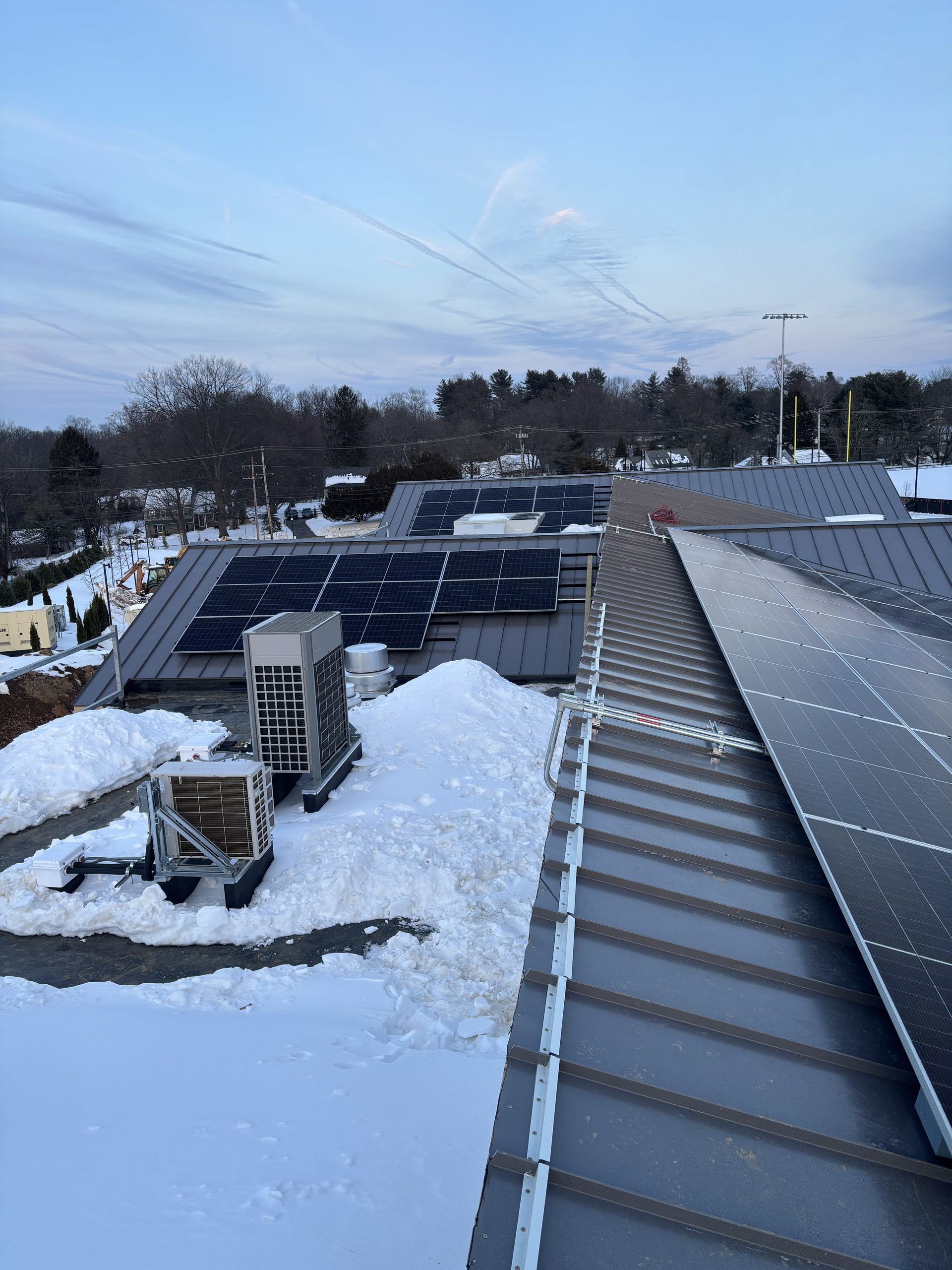
The completed installation has a capacity of 43.38 kilowatts DC and includes 78 solar panels across the school’s main building and garage. It is designed to generate approximately 46,000 kilowatt-hours of electricity annually, enough to offset about 31% of the school’s annual electricity use.
For the school, that means buying less electricity from the grid and having more resources to put toward its educational mission. For students, it creates a real-world example of renewable energy operating right on their own campus.
NOTE: This article is for educational purposes and is not tax, legal, or financial advice. Incentive programs, eligibility requirements, funding availability, and utility rules may change. Confirm current requirements with the administering agency or utility and consult a qualified tax advisor about your organization’s circumstances.
Table of Contents
The Philadelphia School Solar Project at a Glance
| Project detail | Specification |
|---|---|
| Location | Center City, Philadelphia, Pennsylvania |
| School | The Philadelphia School, an independent school serving preschool through eighth grade |
| System donor | Doug Edwards, President of Exact Solar |
| Design and installation | Exact Solar’s in-house team |
| System capacity | 43.38 kW DC / 37.05 kW AC |
| Solar panels | 78 total: 62 Axitec 550-watt panels and 16 Philadelphia Solar 580-watt panels |
| Microinverters | 78 Enphase IQ8-series microinverters |
| Installation areas | Main school building and garage |
| Racking | Unirac GridFlex 5D ballasted racking |
| Utility | PECO |
| Permission to Operate | February 6, 2026 |
| Projected annual production | Approximately 46,000 kWh |
| Projected annual electricity offset | Approximately 31% |
Production and electricity-offset figures are design estimates. Actual results depend on weather, system performance, and the school’s electricity use.
About The Philadelphia School
Founded in 1972, The Philadelphia School is an independent, progressive school in Center City Philadelphia. It serves students from preschool through eighth grade, with a low student-to-teacher ratio and an emphasis on child-centered, inquiry-based education.
The school’s mission includes preparing children “for a future that is impossible to know but not impossible to shape.”
That outlook carries into its approach to learning. Its motto, “Our Classroom is Everywhere,” reflects an educational experience that extends beyond the school building. Students explore Philadelphia’s neighborhoods, institutions, and green spaces. During the spring and fall, they also spend time each week in the school’s “country classroom,” connecting their studies with the natural world.
The rooftop solar installation adds another opportunity to that approach. Students can see how their own school generates electricity and explore the relationships between sunlight, weather, energy use, and environmental responsibility.
Why Solar Can Make Sense for Schools
School budgets have to support a wide range of needs, from teachers and classroom materials to building maintenance and extracurricular programs. Electricity is another recurring expense, and changes in utility rates can make that expense harder to plan for.
A well-designed solar energy system can help by reducing the amount of electricity a school needs to buy from its utility. That can free up resources for the programs and services that directly support students.
Generating electricity on-site can also reduce a school’s exposure to future changes in electricity prices. Sunlight has no fuel cost, although a solar installation still needs monitoring, maintenance, and planning for potential equipment replacement over time.
The financial outcome depends on the building, electricity use, utility rate structure, project cost, and available funding. Schools also continue to pay applicable utility charges and purchase electricity when their solar system is not meeting their needs.
For The Philadelphia School, the donation removed the need for the school to fund the system purchase itself.
Other schools may have different paths to solar. Depending on their eligibility, grants, financing arrangements, and federal incentives may help reduce project costs. We explain several Pennsylvania resources in the FAQ below.
Designing a Solar Installation for a Philadelphia School
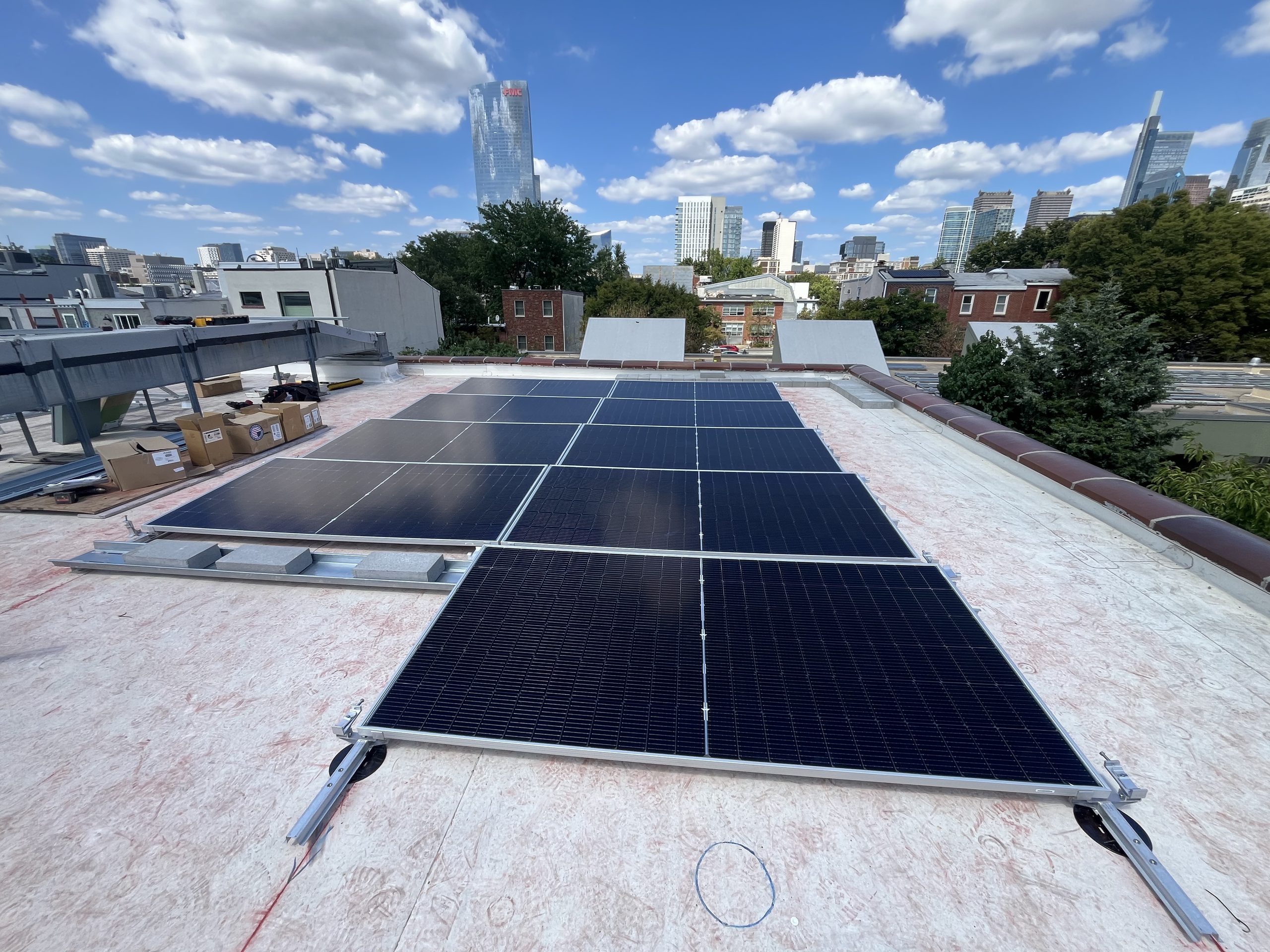
Urban solar projects require careful attention to the available space. Roof layouts, neighboring buildings, existing equipment, and access requirements all influence where panels can go and how much electricity they can produce.
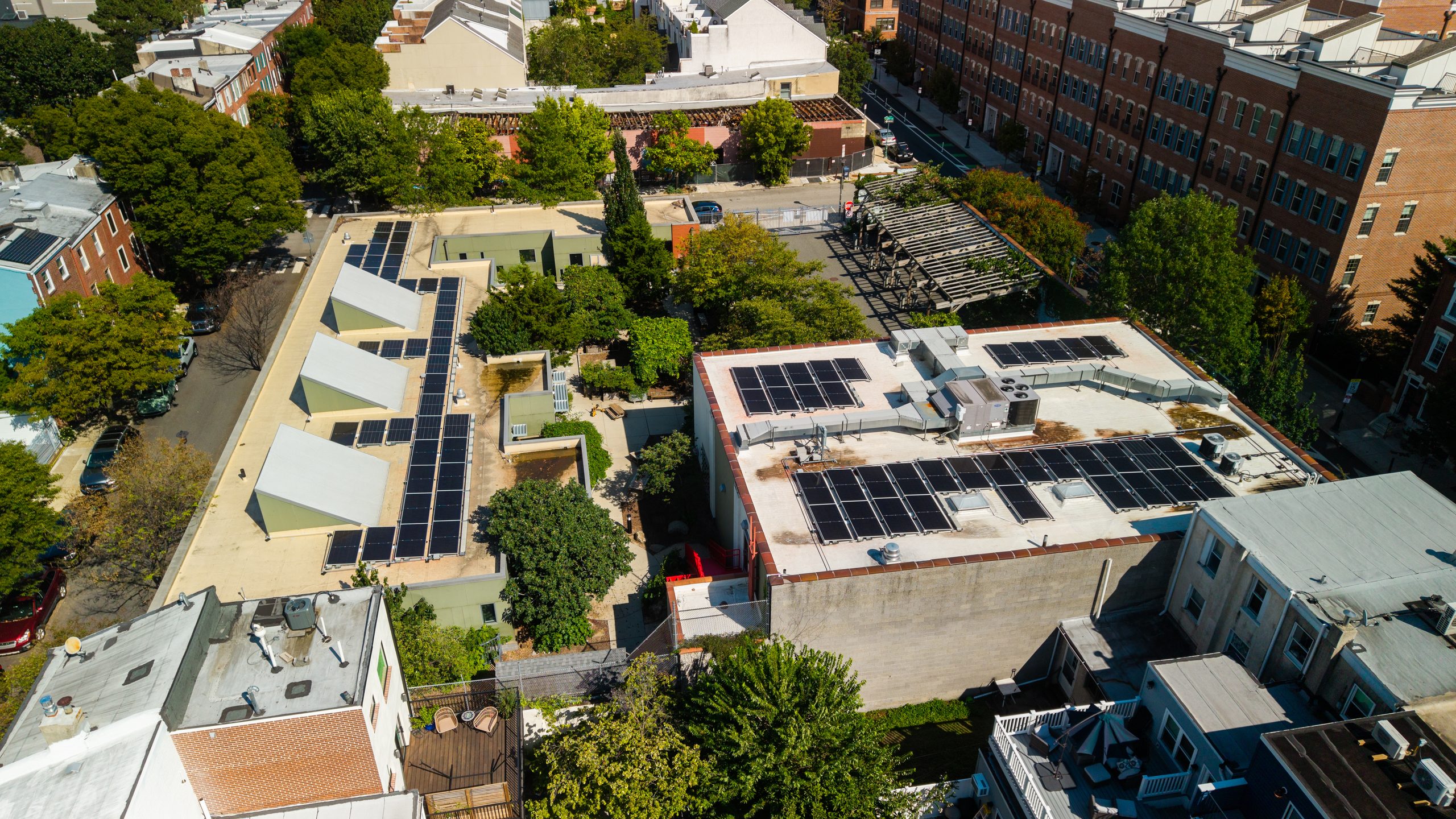
At The Philadelphia School, our team designed the installation across two separate rooftops: the main school building and the garage.
Bringing Two Rooftops Into One System
The installation includes:
- 62 Axitec panels rated at 550 watts each
- 16 Philadelphia Solar panels rated at 580 watts each
Together, those 78 panels provide 43.38 kW of DC capacity.
Each roof has its own orientation and shading conditions. Our team modeled the roofs individually before bringing the two arrays together into a coordinated system connected to the school’s three-phase PECO electrical service.
A single point of interconnection connects the combined solar installation to the school’s electrical system.
“This was a very interesting project. It was our first Enphase project where we used three phase microinverters, with a total system size of 43.38 kW DC.
We used Unirac GridFlex 5D ballasted racking to support the modules. The system was installed across two buildings: the main school building and the garage building. We connected both systems together and used a single point of interconnection for the entire solar system.
The project also qualified for PECO commercial rebates.”
— Ahsan Ullah, Exact Solar Engineer
Using Ballasted Racking on the School’s Roofs
The panels are supported by Unirac GridFlex 5D ballasted racking.
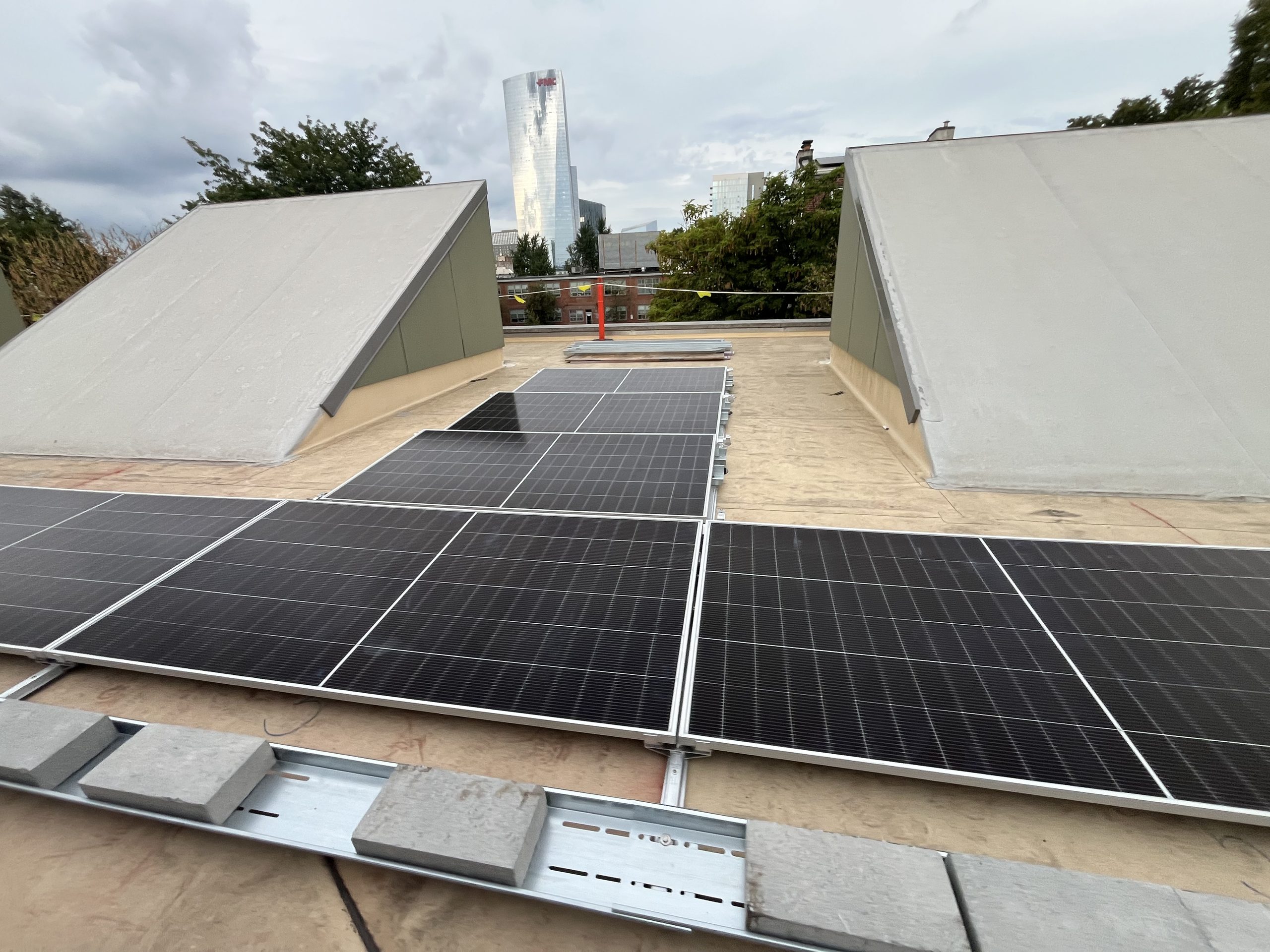
Ballasted racking uses weight, such as concrete blocks, to help secure the solar array. On suitable flat or low-slope roofs, this approach can reduce the need for attachments that penetrate the roof membrane.
The choice of racking depends on more than roof shape. Engineers also consider the roof’s condition and structural capacity, wind forces, snow loads, drainage, and maintenance access. Some designs require a combination of ballast and mechanical attachments.
Solar installations need to handle years of exposure to heat, cold, rain, and snow. For a school, the mounting design also needs to work alongside the building’s roofing system and leave appropriate access for inspection and service.
Why We Used Microinverters
Solar panels generate direct-current electricity, or DC. Inverters convert that electricity into alternating current, or AC, which the building can use.
For this project, we paired each panel with its own Enphase IQ8-series microinverter.
That design allows panels to operate independently. If shade reduces production from one panel, that panel does not directly limit the output of other panels through a shared series connection.
This was useful at The Philadelphia School, where the arrays occupy two rooftops with different orientations and shading conditions. Microinverters do not eliminate the effects of shade, but they help manage differences in production across the installation.
“This is the first three-phase commercial Enphase system Exact Solar has installed. We used Enphase IQ8P microinverters, which work with the school’s 208/120V service.”
— Stanislav Kvochak, Exact Solar Engineer
The system also uses Enphase’s monitoring platform, Enlighten, to provide visibility into solar production, including panel-level performance.
For the school, monitoring helps show how the installation is working. If teachers choose to incorporate that information into lessons, it can also become an educational resource.
Expected Energy, Financial, and Environmental Impact
The system is designed to produce approximately 46,000 kWh of electricity per year.
A kilowatt-hour measures energy. While the system’s kilowatt rating describes its generating capacity, annual kilowatt-hours describe how much electricity it is expected to produce over time.
Offsetting About 31% of Annual Electricity Use
The projected production is equivalent to approximately 31% of The Philadelphia School’s annual electricity consumption.
That does not mean solar will supply exactly 31% of the school’s needs at every moment. Production changes throughout the day and across the seasons. The school’s electricity use also varies.
It also does not automatically mean a 31% reduction in the total utility bill. Financial savings depend on when electricity is generated and used, applicable net-metering arrangements, and charges that remain on the bill.
The practical benefit is that on-site electricity production can reduce the amount the school needs to purchase from PECO.
Over time, those avoided purchases can help support the school’s operating budget and reduce its exposure to changes in electricity prices. The donation makes this project especially meaningful because the school can benefit from solar generation without having purchased the system itself.
Generating Renewable Electricity on Campus
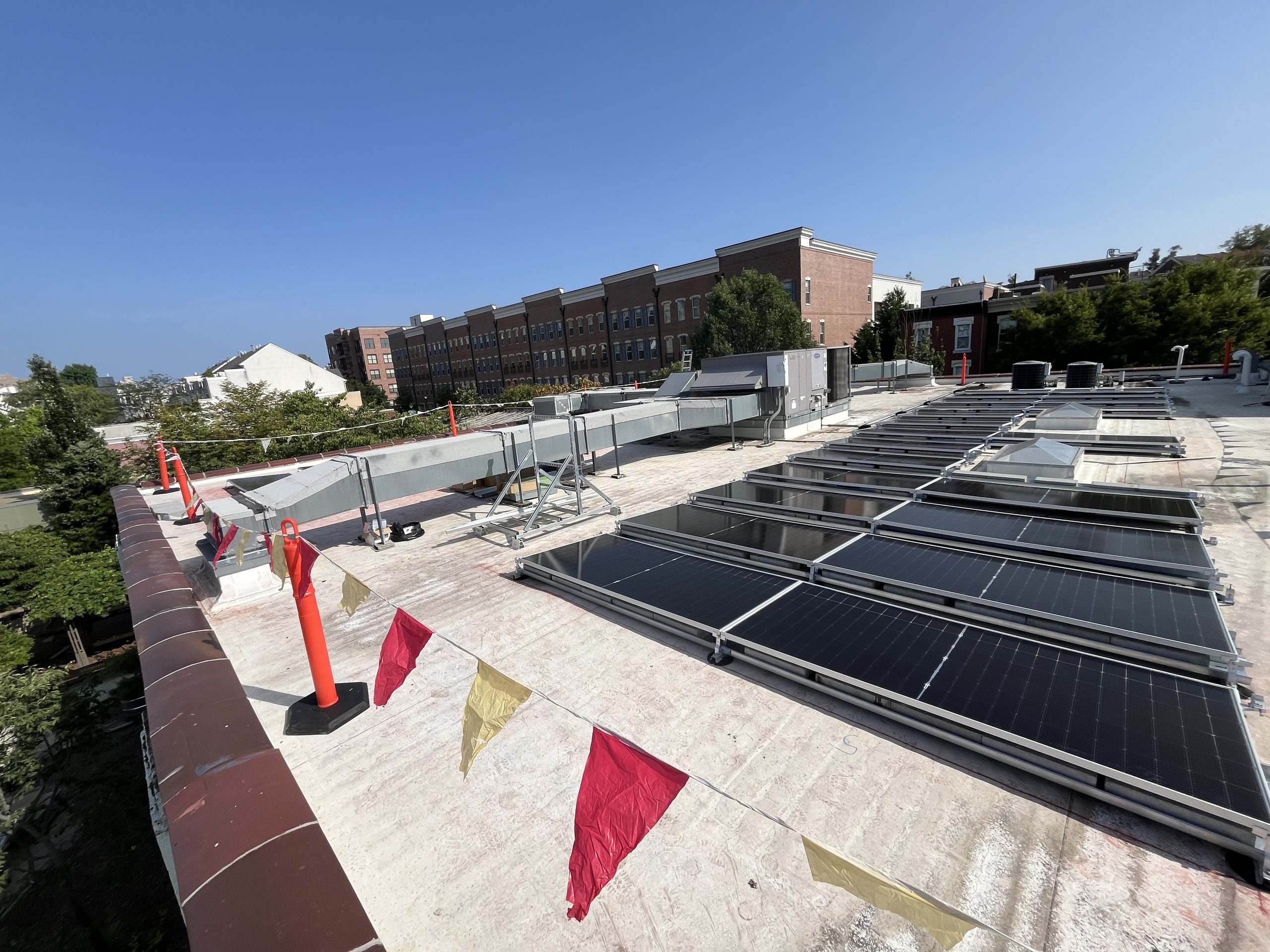
The system’s projected annual production of 46,000 kilowatt-hours is roughly equivalent to the electricity used by four average homes in a year. Generating that electricity from sunlight instead of the grid avoids an estimated 17 tons of carbon dioxide annually.
Over the system’s design life, those estimated environmental benefits add up to the equivalent of driving more than 300,000 fewer miles or planting several thousand trees.*
For The Philadelphia School, the installation also provides a visible connection between the energy the campus uses and the opportunity to generate some of that energy on-site.
*Environmental estimates and comparisons were calculated using the EPA’s Greenhouse Gas Equivalencies Calculator.
Connecting Solar Energy With Classroom Learning
The Philadelphia School already connects classroom learning with experiences in the city and outdoors. Its solar installation offers another way to make those connections.
If the school chooses to use production data in lessons, students could explore questions such as:
- How does solar production change between sunny and cloudy days?
- Why does the system generate different amounts of electricity in summer and winter?
- How do shade and panel location affect production?
- How does the electricity generated compare with the electricity used by the school?
These questions can support lessons in science, math, and environmental studies. Students can work with measurements from a familiar place and see how the concepts they are learning apply to a working energy system.
The installation creates that opportunity without requiring every student to understand the engineering behind it. A simple question about why production changed from one day to the next can lead to a useful discussion about weather, seasons, and energy.
More School Solar Projects From Exact Solar
The Philadelphia School joins a growing list of schools that have worked with Exact Solar to generate renewable electricity, manage energy costs, and create opportunities for students to learn about solar.
Our school projects range from rooftop installations serving school buildings to smaller systems supporting hands-on educational programs. Each starts with the needs of the school, the available space, and the people who use it.
Sandy Run Middle School
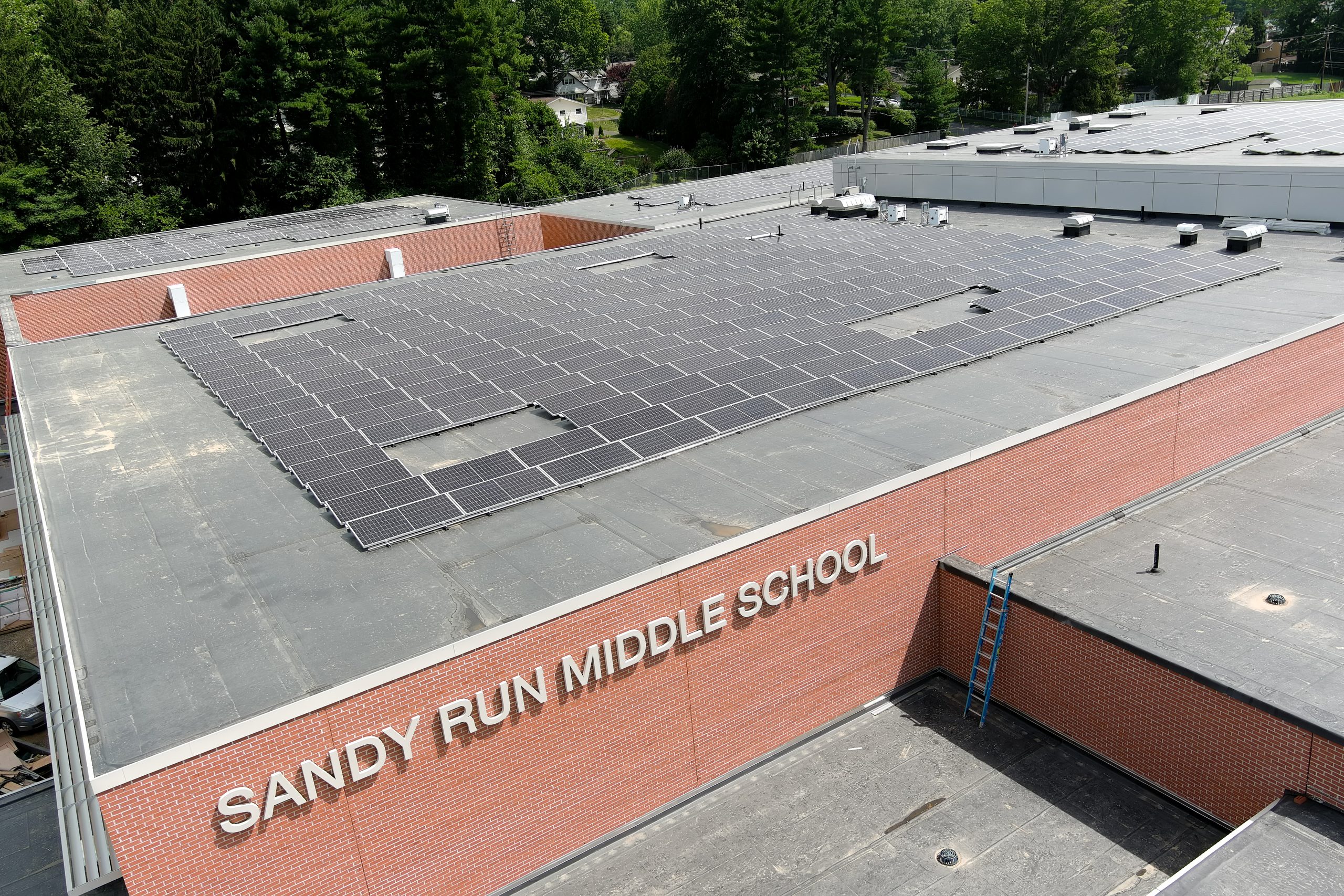
At Sandy Run Middle School in Dresher, part of the Upper Dublin School District, Exact Solar installed a 280 kW rooftop solar system with 700 panels.
Our team performed the solar installation under Boro Construction, the project’s prime electrical contractor, as part of the new school construction. The system was commissioned in August 2022.
The installation uses ballasted racking to secure the panels without penetrating the roof membrane. Our team also completed electrical testing and commissioning to verify that the system was ready to operate.
Sandy Run is another example of how a school’s rooftop can become a long-term source of renewable electricity while supporting the building’s design and operational needs.
Holland Middle School
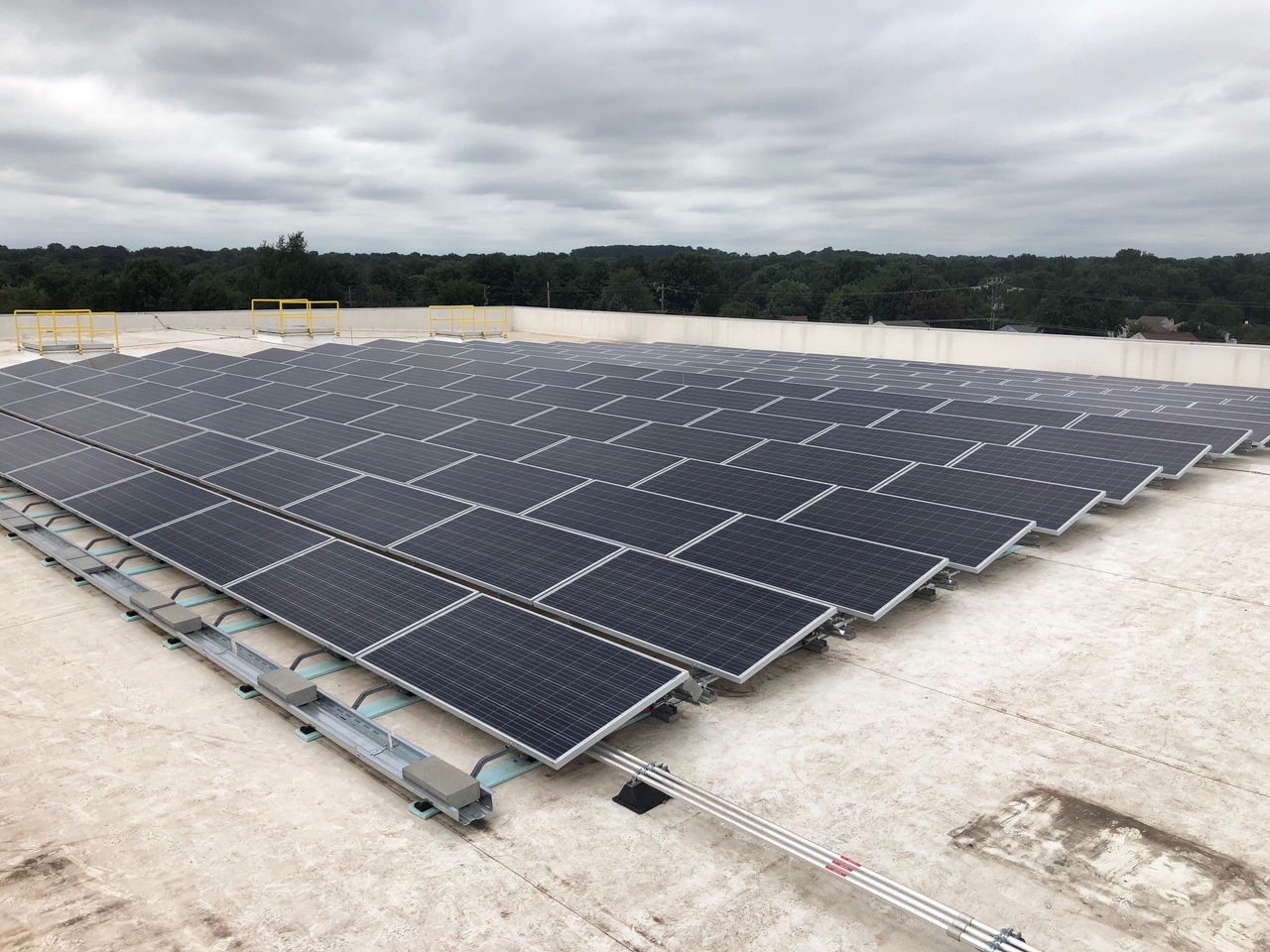
Exact Solar has also completed solar installations for Council Rock School District at Holland Middle School and Newtown Middle School.
At Holland Middle School, our team installed a 112 kW system that was later recognized by PV Magazine. At Newtown Middle School, we installed a 40.95 kW rooftop system.
These projects demonstrate how solar can be adapted to different school buildings, with system size and layout shaped by the available roof space and project requirements.
Read more about the Holland Middle School solar project.
ASPIRA Bilingual Cyber Charter School in Philadelphia
At ASPIRA Bilingual Cyber Charter School in Philadelphia, Exact Solar installed a 14.64 kW solar system to power an aquaponic greenhouse.
The project connects renewable energy with food production and hands-on learning. Students can explore how fish, plants, water, and electricity interact within an aquaponic growing environment.
The greenhouse also connects with the school’s culinary and environmental education goals, creating opportunities to grow produce, prepare food, and learn about entrepreneurship.
The project was featured by WHYY and demonstrates how solar can support a specific educational program alongside its environmental benefits.
Learn more about Exact Solar’s work at ASPIRA.
Harry S. Truman High School
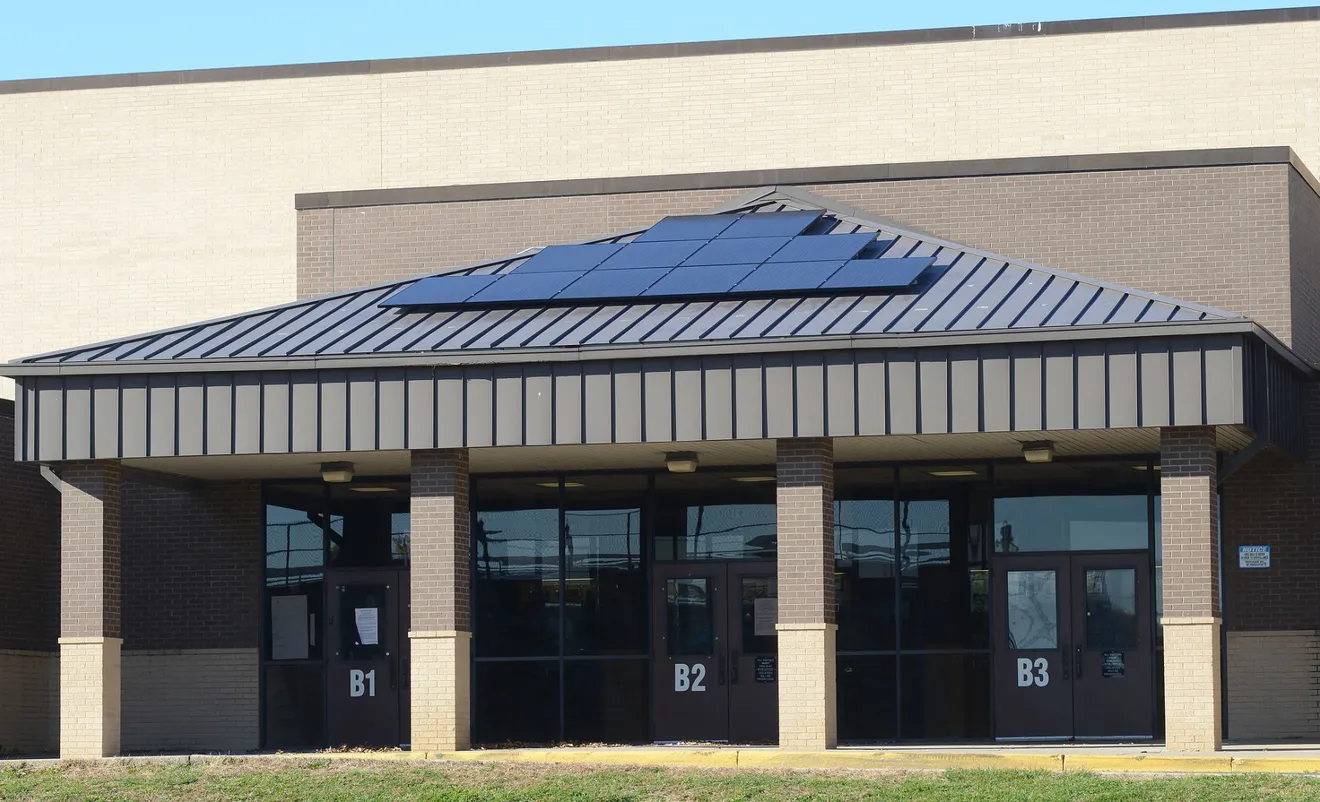
At Harry S. Truman High School in Bristol Township, a student-led effort brought solar energy to campus.
The Environmental Club began pursuing the project in 2008. Students raised money through activities including a polar plunge, sales of greenhouse-grown sunflowers and handmade chocolates, and donations collected at community recycling events.
After a student contacted Exact Solar, our team offered to donate the installation labor if the club could raise enough money for the panels and equipment. By spring 2016, the club had raised $7,000.
Following school board approval, 15 solar panels were installed in November 2016. The project gave students a direct role in bringing renewable energy to their school and showed what sustained effort and community support can accomplish.
Read more about Truman’s student-led solar project.
Conestoga High School
Our work with Tredyffrin/Easttown School District includes a 59 kW solar project at Conestoga High School’s new athletic field house.
The system is projected to generate close to 70,000 kWh annually, helping reduce electricity purchased from the utility for district operations.
The project also reflects the role students can play in encouraging sustainability. Students involved in Sunrise Berwyn advocated for a stronger district commitment to addressing climate change, helping build support for projects like this one.
Lansdowne Friends School
At Lansdowne Friends School in Delaware County, Exact Solar installed a 23.94 kW solar energy system in 2025, using 57 VSUN panels paired with SolarEdge inverters.
Solar fits into the school’s broader commitment to environmental stewardship. Its Green Spaces, Growing Minds capital campaign includes solar alongside plans for more efficient buildings and outdoor spaces designed for learning, play, and a changing climate.
The school identifies reducing energy costs and supporting long-term sustainability as goals for its solar investment. Its wider campus plans include rain gardens, shade trees, and improvements to heating, cooling, windows, and doors.
North Pocono School District
Exact Solar was recently selected through North Pocono School District’s request for proposals process for a solar project spanning five schools.
The project, currently in progress, is planned to include approximately 1.5 megawatts of rooftop solar capacity across:
- North Pocono High School
- North Pocono Intermediate School
- North Pocono Middle School
- Moscow Elementary School
- Jefferson Elementary School
Collectively, the proposed systems are expected to generate approximately 1.7 million kilowatt-hours of electricity annually, offsetting roughly 40% of the district’s annual electricity use.
Our scope includes design, engineering, permitting, utility interconnection, installation, and commissioning. Coordinating work across five active schools also requires planning around school schedules, building access, and safety.
The project is intended to reduce long-term electricity costs while creating opportunities for students to learn about renewable energy through the systems operating at their own schools.
North Pocono’s system size, production, and electricity-offset figures are project estimates and may change as design and construction progress.
Could Solar Work for Your Philadelphia School?
The Philadelphia School’s project shows how an urban campus can use more than one rooftop to generate a meaningful share of its electricity.
Every school’s opportunity is different. The starting point is understanding the building, its electricity use, and the organization’s goals.
Exact Solar’s commercial solar team can help schools in Philadelphia and the surrounding region evaluate:
- Available roof or ground space
- Roof condition and structural requirements
- Current electricity use and utility costs
- Expected solar production
- Potential funding and financing options
- Opportunities to support student learning
We will explain the numbers and the factors that affect them, including which programs may apply to your school.
Schedule a free consultation with Exact Solar to explore whether solar makes sense for your campus. There is no cost and no pressure.
Frequently Asked Questions About Solar for Schools in Philadelphia
What Programs Can Help Pennsylvania Schools Go Solar?
Several resources may help schools evaluate or fund solar projects. Eligibility varies by school type, location, and program requirements.
These are resources for schools exploring their options. They should not be interpreted as a list of programs that funded The Philadelphia School’s donated installation.
Pennsylvania Solar for Schools Grant Program
This program supports solar projects at specified eligible educational institutions, including school districts, charter schools, and certain other institutions. Independent private schools should not assume they qualify.
Review the program page, guidelines, and frequently asked questions for current requirements.
Our guide to Pennsylvania’s Solar for Schools program provides additional background.
Pennsylvania Solar for Schools Loan Program
The current loan pilot is limited to qualifying school districts in southwestern Pennsylvania. It is not currently a funding option for Philadelphia schools.
Schools elsewhere in the state can review the official loan program page to understand its geographic and eligibility requirements and check for updates.
Net Metering
Net metering can provide credits for eligible solar electricity exported to the grid. The value and treatment of those credits depend on the applicable utility rules and account details.
Read our guide to net metering.
Solar Alternative Energy Credits
Eligible solar systems may generate credits associated with their renewable electricity production. Qualification, ownership, and credit value need to be considered when evaluating a project.
Visit the Pennsylvania Public Utility Commission’s Alternative Energy Portfolio Standards page for more information.
Pennsylvania Solar Center’s GET Solar for Schools
The Pennsylvania Solar Center offers resources and technical assistance to help schools explore solar, including project feasibility, procurement, and financing considerations.
Visit GET Solar for Schools for current offerings and participation details.
Is Solar a Good Fit for a School Building in Philadelphia?
It can be. Many schools have characteristics that make solar worth evaluating:
- Flat or low-slope roofs with usable space
- Electricity demand during daylight hours
- Long-term plans to remain in the same building
In Philadelphia, the assessment should also account for nearby buildings, shade, rooftop equipment, access, and the condition of the roof.
A school does not need a large open campus to explore solar. The Philadelphia School’s project demonstrates how separate rooftop areas can contribute to one installation.
Does a School Have to Pay for the Whole System Upfront?
Not necessarily. The options depend on the school’s legal status, finances, project structure, and eligibility for available programs.
Some qualifying tax-exempt organizations may be able to receive the value of eligible federal clean-energy tax credits through elective pay. This requires meeting the applicable requirements; it is not an automatic payment simply because an organization is a school or nonprofit.
Grants and financing arrangements may also help eligible schools manage project costs.
The Philadelphia School’s installation followed a different path: Doug Edwards donated the system. That distinction matters when comparing its financial circumstances with another school’s proposed project.
Will Solar Power Our Entire School?
That depends on the relationship between usable installation space, solar production, and the school’s electricity needs.
The Philadelphia School’s system is designed to offset approximately 31% of its annual electricity use. Another school might offset a higher or lower share.
A larger roof can create more room for panels, but the percentage also depends on shading, equipment, electricity consumption, and other site conditions. The best way to estimate it is to compare a proposed design with the school’s actual usage.
Can a Solar Energy System Become a Classroom Tool?
Yes. Monitoring data can help students explore electricity production, weather, seasonal changes, and energy use.
At The Philadelphia School, the Enphase monitoring platform provides information that could support those lessons if teachers choose to incorporate it.
The educational approach can be adapted to different ages, from observing how clouds affect production to analyzing longer-term data in math or science classes.
How Long Does a School Solar Project Take?
The timeline depends on the size and complexity of the installation, engineering requirements, permitting, equipment availability, and utility review.
School schedules and roof work can also affect when installation should take place.
Exact Solar’s in-house team manages the process from design and engineering through installation and coordination of utility interconnection and Permission to Operate. We can explain the anticipated steps and timing after reviewing a specific site.
How Can Our School Get Started?
Start with a conversation about your building, electricity use, and goals.
Exact Solar will help assess the available space, explain the expected production, and review potential costs and funding options. From there, your team can decide whether a more detailed evaluation makes sense.