If your organization has considered solar but hasn’t moved forward, an additional federal tax incentive may be worth a closer look.
Qualifying solar projects located in an energy community can receive an additional 10 percentage points on their federal investment tax credit. For a project eligible for the 30% credit, that can bring the total to 40% of eligible project costs.
That difference can meaningfully affect the cost of going solar for a business, school, municipality, nonprofit, or house of worship.
The IRS’s June 2026 energy community update includes counties throughout southeastern Pennsylvania and parts of New Jersey. If your property did not qualify when you last explored solar, checking again could change the financial picture.
At Exact Solar, we help organizations understand how solar could work for their property, what savings to expect, and which incentives may apply. This guide explains:
- What an energy community is and how an area qualifies
- What the June 2026 update means for Pennsylvania and New Jersey
- How the energy community bonus can increase a qualifying solar tax credit
- Which businesses and organizations may benefit
- How to check your location and prepare to claim the credit
- How battery storage and other incentives fit into the picture
- What to know about federal solar tax-credit deadlines
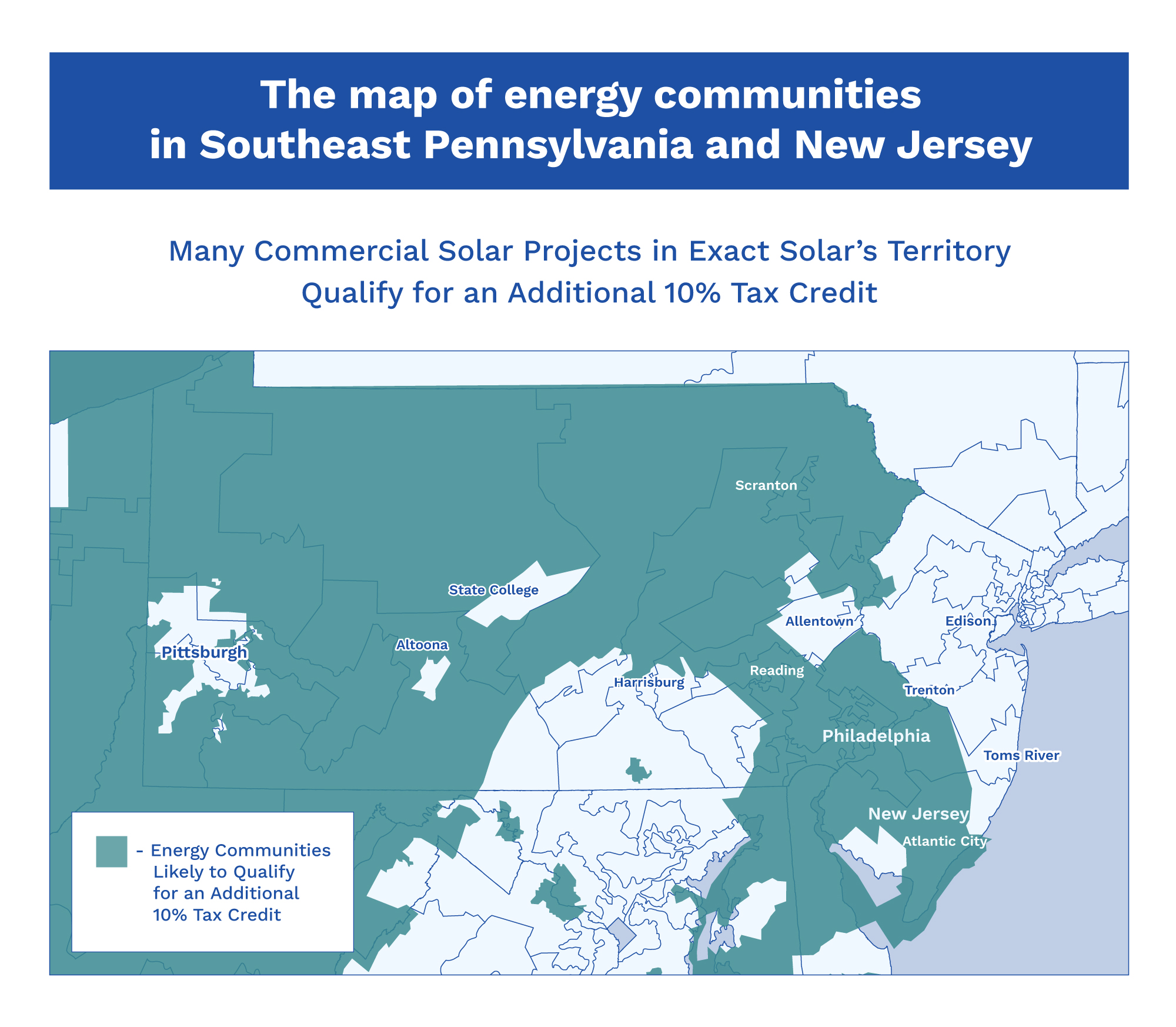
Image caption: Solar energy systems installed by Exact Solar at Camp Nock-a-Mixon in Kintnersville, Pennsylvania.
NOTE: This article is for educational purposes only and does not constitute tax, legal, or accounting advice. Tax laws, IRS guidance, and energy community designations are subject to change. Eligibility and credit amounts depend on your organization and project. Confirm current requirements with a qualified tax professional before making financial decisions or claiming any credit.
Table of Contents
What Is an Energy Community?
An energy community is a location that meets specific federal criteria related to fossil fuel employment, coal facility closures, or certain previously developed properties known as brownfields.
The Inflation Reduction Act of 2022 established the energy community bonus to encourage clean energy investment in these locations.
The reasoning behind the incentive is straightforward. Communities that have depended on coal, oil, or natural gas can face economic challenges when employers close or reduce operations. Those changes may affect local jobs, tax revenue, and the businesses that supported those industries. Some properties also have contamination concerns that complicate redevelopment.
Additional investment in solar and other clean energy projects can help bring new economic activity to these areas.
For a property owner, the practical question is whether the proposed solar installation is in a qualifying location. Your organization does not have to work in the energy industry to benefit.
The Three Types of Energy Communities
There are three main qualifying categories:
1. Brownfield sites
A brownfield is generally a property where redevelopment or reuse may be complicated by the presence or potential presence of hazardous substances or pollutants. Specific federal definitions and exclusions apply, so an older industrial property does not automatically qualify.
2. Areas with a history of fossil fuel employment and qualifying unemployment
This category covers metropolitan and nonmetropolitan statistical areas. These are geographic groupings used by federal agencies and can include multiple counties.
The employment pathway requires at least 0.17% direct fossil fuel employment at some point after 2009, along with an unemployment rate at or above the national average for the previous year. The law also includes a local tax-revenue pathway.
3. Areas affected by coal closures
This category includes census tracts where a coal mine closed after 1999 or a coal-fired generating unit retired after 2009. Directly adjoining census tracts can also qualify.
The U.S. Treasury’s energy community guidance explains these categories.
Do You Have to Join an Energy Community?
No. There is no organization to join or utility program to enroll in.
“Energy community” is a location-based designation used to determine eligibility for certain federal clean energy incentives. It is also separate from community solar, which generally allows customers to subscribe to electricity production from a shared solar project.
A school, warehouse, farm, municipal building, or house of worship can be located in an energy community even if its own property has never housed a fossil fuel operation.
Which Pennsylvania and New Jersey Locations Qualify Under the June 2026 Update?
The IRS periodically updates its energy community information. For the statistical-area category, annual unemployment data can change which areas qualify.
IRS Notice 2026-39 establishes an updated statistical-area list effective June 10, 2026. That designation remains applicable until Treasury and the IRS publish a replacement based on 2026 unemployment data.
For organizations in our region, the list includes several counties where Exact Solar installs commercial solar systems.
| Region | Examples of counties included in the June 2026 statistical-area list |
|---|---|
| Southeastern Pennsylvania | Bucks, Chester, Delaware, Montgomery, and Philadelphia |
| New Jersey | Atlantic, Burlington, Camden, Cape May, Gloucester, and Salem |
These counties appear in Appendix 1 of Notice 2026-39, published in Internal Revenue Bulletin 2026-27.
A location outside these counties may still qualify through another energy community category. Likewise, being located in a listed county does not establish that a project meets every requirement for the tax credit.
The update gives organizations a good reason to revisit an earlier eligibility review. Your property may qualify under information that was not applicable when you first considered solar.
You can begin with the Baker Tilly Energy Community Mapping Tool, then confirm the result against the applicable IRS guidance with your project team and tax advisor.
How Does the Energy Community Solar Tax Credit Work?
Federal solar tax credits are still available for qualifying commercial projects, although the rules and deadlines have changed.
The homeowner Residential Clean Energy Credit ended for expenditures after December 31, 2025. Commercial solar incentives follow separate provisions and remain available to qualifying projects that meet the applicable requirements. See the IRS explanation of the residential credit.
For many new commercial solar projects, the relevant incentive is the Clean Electricity Investment Credit, also called Section 48E.
Understanding the 30% Commercial Solar Tax Credit
The statutory base credit is 6%. A project can qualify for the increased 30% rate by meeting prevailing wage and apprenticeship requirements or an applicable exception.
One important exception applies to qualifying facilities with a maximum net output of less than 1 megawatt, measured in alternating current, or AC.
Prevailing wage requirements generally address worker pay, while apprenticeship requirements address the use of qualified apprentices. Your installer and tax advisor should determine which requirements apply to your project. The IRS overview of the Clean Electricity Investment Credit explains the credit structure.
How the Energy Community Bonus Can Increase the Credit to 40%
For a project that qualifies for the increased credit rate, the energy community bonus adds 10 percentage points.
That means:
30% federal investment tax credit + 10 percentage points for energy community eligibility = 40% of eligible project costs.
For example, consider a solar project with $500,000 in eligible costs:
| Scenario | Potential credit rate | Illustrative credit amount |
|---|---|---|
| Project qualifies for the 30% credit | 30% | $150,000 |
| Same project also qualifies for the energy community bonus | 40% | $200,000 |
| Additional value from the energy community bonus | 10 percentage points | $50,000 |
The 10-percentage-point increase applies to eligible project costs. It is not calculated as 10% of the original $150,000 credit.
If the project also meets domestic content requirements, it may qualify for another 10-percentage-point bonus, bringing the total federal investment tax credit to 50% of eligible project costs. On the same $500,000 project, that would mean a potential credit of $250,000.
Domestic content requirements address the use of qualifying U.S.-produced materials and manufactured products. These requirements should be considered during equipment selection and verified with your tax advisor. Learn more in our guide to the domestic content bonus credit.
Projects that do not qualify for the increased rate generally receive a smaller energy community bonus of 2 percentage points. IRS Notice 2026-39 explains that distinction.
These figures illustrate how the calculation works. A tax credit is not automatically an upfront discount or cash reimbursement to a business. How and when your organization realizes its value depends on its tax position and any available payment or transfer options.
For more background, read our guide to claiming the commercial solar tax credit in 2026.
If you would like to see how the numbers could look for your property, get a free estimate from Exact Solar.
Which Businesses and Organizations Can Benefit?
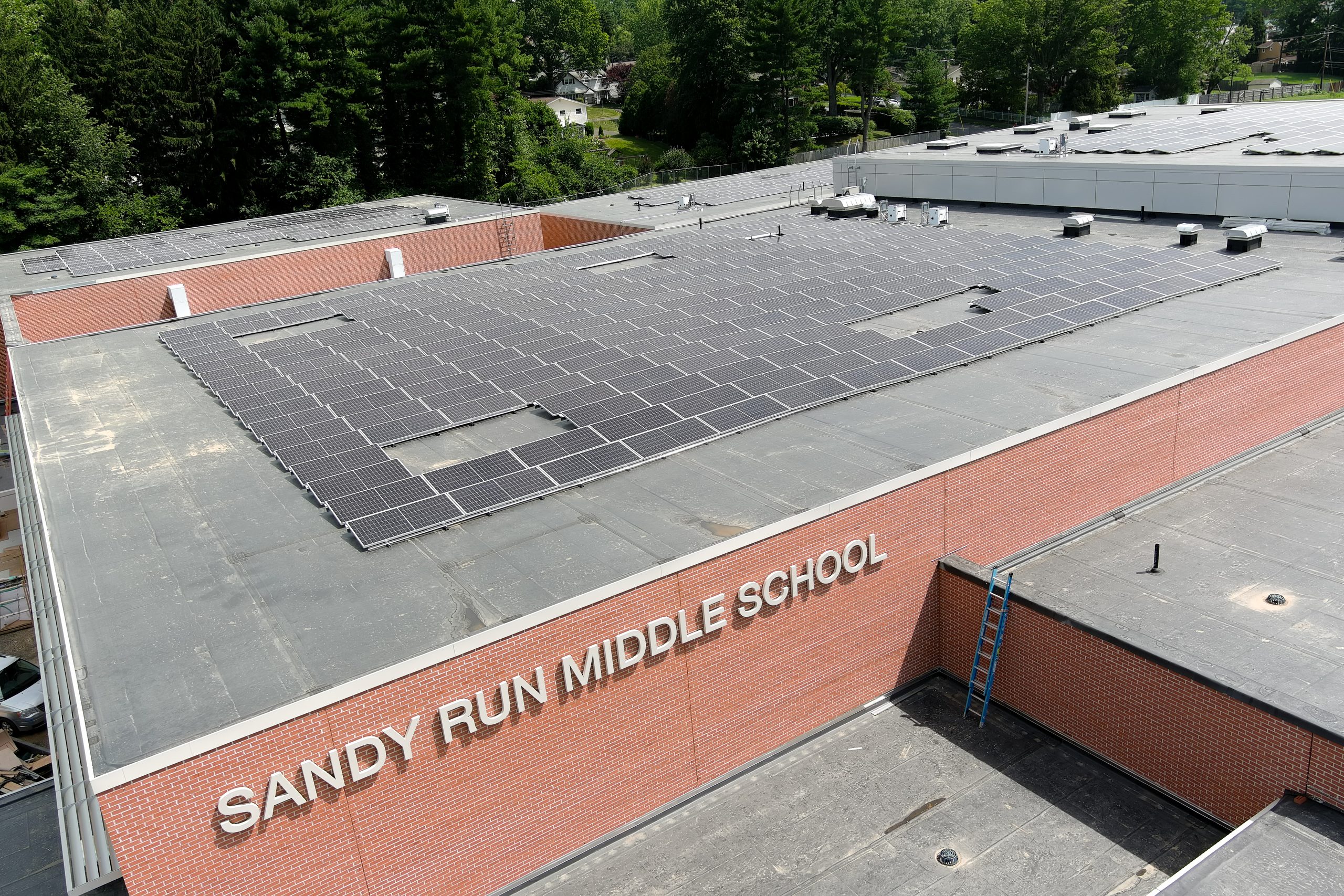
The energy community bonus can apply to more than privately owned businesses.
Eligible tax-exempt organizations and government entities may also benefit through elective pay, sometimes called direct pay. This mechanism allows qualifying organizations to receive the value of certain clean energy tax credits as a payment from the IRS, even when they do not owe federal income tax.
Potential projects include solar installations serving:
- Township, borough, and municipal buildings.
- Public and private schools.
- Nonprofit campuses.
- Churches, synagogues, mosques, and other houses of worship.
- Warehouses and distribution centers.
- Manufacturing and industrial facilities.
- Office buildings.
- Farms and agricultural businesses.
- Water and sewer authority facilities.
- Apartment and multifamily properties.
The building’s use alone does not determine eligibility. The project’s ownership, location, size, timing, and equipment all matter.
For example, an organization purchasing its solar system has a different ownership arrangement from one buying electricity through a power purchase agreement. The party entitled to claim the credit must be established as part of the project’s financial planning.
Organizations pursuing elective pay should also review domestic content requirements early. For certain projects, failing to meet those requirements or an applicable exception can reduce the elective payment. The IRS elective pay FAQs explain these additional considerations.
How to Check Eligibility and Claim the Energy Community Bonus
Your installer and tax advisor have different roles in this process.
Your installer helps develop the system design, equipment plan, construction schedule, and project records. Your tax advisor evaluates how the rules apply to your organization and prepares the appropriate filings.
Bringing both into the conversation early can help you understand the available incentives before making major project decisions.
Step 1: Check Your Project’s Energy Community Location
Start by entering the installation address into the Baker Tilly Energy Community Mapping Tool.
Use the map as an initial screening tool, then verify the designation using the underlying IRS information.
For the June 2026 statistical-area update, review Appendix 1 of Notice 2026-39 in the IRS bulletin. It identifies qualifying counties and county equivalents.
If your county is absent, ask whether the specific site could qualify under the coal-closure or brownfield category. A county list alone does not cover every qualifying pathway.
Keep a record of the information used, including the applicable notice, map layer, and date. Your tax advisor should confirm which designation applies to your project.
Step 2: Evaluate Your Property With a Commercial Solar Installer
Location is one part of the evaluation. A useful proposal should also explain:
- How much electricity your organization uses and when it uses it.
- The available roof or ground space.
- Roof condition and any work needed before installation.
- Expected system size and annual electricity production.
- Utility interconnection requirements.
- Estimated project costs and potential savings.
- Available incentives and the assumptions behind them.
- Whether battery storage would provide additional value.
This helps your organization evaluate solar as a long-term investment, with a clear understanding of both the project and its financial assumptions.
Exact Solar works with businesses, municipalities, schools, and nonprofits throughout Pennsylvania and New Jersey. Schedule a no-pressure consultation to discuss your property and goals.
Step 3: Confirm the Dates That Determine Tax Credit Eligibility
Two dates matter throughout the tax-credit process:
- Beginning of construction: The date the project satisfies the applicable IRS standard for having started construction.
- Placed in service: The date the completed system is ready and available for its intended use.
For investment tax credits, energy community eligibility is generally determined when the project is placed in service. A special rule may preserve the designation for a qualifying project that began construction while its location was an energy community. See IRS Notice 2023-29.
These dates must be supported by the project’s actual facts and records. Your organization cannot simply choose whichever date produces the better result.
Also, preserving an energy community designation does not automatically satisfy the separate deadline for the underlying solar tax credit. Both requirements need to be reviewed.
Your installer can provide construction and completion documentation, while your tax advisor determines how those records support the credit claim.
Step 4: Gather Your Solar Project Documentation
Create a project file early and update it as the work progresses.
Useful records include:
- Signed contracts, invoices, and payment records.
- An itemized breakdown of potentially eligible solar and storage costs.
- Separately identified roof repairs, building improvements, and other costs requiring their own tax review.
- Documents supporting the beginning-of-construction date.
- Completion, commissioning, and utility interconnection records.
- System capacity in both AC and DC.
- The installation address and geographic coordinates.
- Evidence supporting the energy community designation.
- Equipment specifications and applicable sourcing documentation.
- Prevailing wage and apprenticeship records, when required.
Keeping these records organized during construction is easier than reconstructing them when it is time to file.
If your project is also pursuing the domestic content bonus, additional documentation and a certification statement are required. The IRS domestic content bonus guidance describes those requirements.
Step 5: Register for Elective Pay if Applicable
Eligible tax-exempt and government entities must complete IRS pre-filing registration before making an elective pay election.
Registration takes place through IRS Energy Credits Online. Your organization will need a registration number for each applicable credit property.
The IRS recommends registering after the property is placed in service and at least 120 days before the return’s due date, including extensions. Registration does not itself establish that the project qualifies for a credit. See the IRS registration instructions.
Allow time for this step when planning your filing schedule. The payment does not arrive simply because installation is complete or a registration number has been issued.
Our guide to how tax-exempt entities can claim elective pay provides additional background on the process.
Step 6: File the Required Tax Forms
Your tax preparer should use the forms and instructions applicable to the year the credit is claimed.
Common forms include:
Form 3468, Investment Credit
This form calculates the investment credit. In the 2025 version, Section 48E is reported in Part V and Section 48 in Part VI. Separate facility or property reporting may be required.
Form 3800, General Business Credit
This form is also part of reporting the credit, including applicable elective pay claims. See the IRS Form 3468 instructions.
Form 7220, Prevailing Wage and Apprenticeship Verification and Corrections
This form applies when claiming the increased credit based on meeting prevailing wage and apprenticeship requirements. A qualifying exception can change the filing requirements, so system size alone should not be used as the entire filing analysis. See the Form 7220 instructions.
Form 990-T
Many tax-exempt and government entities use this return to make an elective pay election, even if they would not otherwise file it. Supporting forms and the registration number must also be included as required.
The IRS provides a Form 990-T elective payment walkthrough, including an example involving a municipality’s solar project.
Step 7: Keep Records After Installation
Keep your project documentation accessible after the system is operating and the credit has been claimed.
Investment tax credits generally have a five-year recapture period. Certain changes, such as a sale or a change in qualifying use, can require repayment of part of the credit. Other ongoing requirements may also apply.
Ask your tax advisor how long to retain each category of records and what events should trigger a review. Keep copies of filed returns, supporting calculations, certifications, and registration information alongside the construction records.
Can Commercial Battery Storage Qualify for the Energy Community Bonus?
Qualifying commercial battery storage can also benefit from federal investment tax credits and the energy community bonus.
For some organizations, batteries can improve the financial and operational value of a solar project. Whether they make sense depends on the building’s electricity use, utility rate, and backup-power needs.
How Batteries Can Reduce Commercial Demand Charges
Many commercial electric bills include demand charges. These charges are based on the highest level of electricity demand measured during a billing period, rather than only the total electricity consumed.
A battery can discharge during periods of high demand to reduce the amount of power drawn from the grid. This is commonly called peak shaving.
For example, a facility might experience a short increase in demand when several large pieces of equipment run simultaneously. A properly designed battery may help reduce that peak.
The savings depend on the utility’s billing rules and the facility’s operating patterns. Reviewing interval usage data can help determine whether demand management is a worthwhile opportunity.
Learn more in our explanation of commercial demand charges.
How Battery Storage Tax Credits Fit Into Your Project
An eligible battery project that qualifies for the increased credit rate may receive a 30% investment credit, an additional 10 percentage points for energy community eligibility, and another 10 percentage points if it meets domestic content requirements.
That combination can bring the credit to 50% of eligible battery project costs, subject to the applicable rules.
Energy storage is excluded from the accelerated solar and wind termination provision described in IRS Notice 2025-42. This gives storage a different incentive timeline, although storage projects still have their own eligibility and sourcing requirements.
For a combined solar and battery installation, costs must be allocated appropriately. Solar costs cannot simply be labeled as battery costs to qualify for different treatment.
Our team can evaluate solar and storage together, explain the expected benefits of each, and provide the project information your tax advisor needs to review the incentives.
Combining the Energy Community Bonus With Other Solar Incentives
A commercial solar project may benefit from several programs at the same time. Each serves a different purpose, so it helps to understand how they fit together.
Federal investment tax credit
This reduces the eligible project owner’s federal tax liability, subject to the applicable rules. Certain organizations can access its value through elective pay.
Energy community bonus
This increases the investment credit percentage for projects meeting the location and other requirements.
Domestic content bonus
Projects meeting applicable U.S. manufacturing and sourcing requirements may qualify for an additional credit increase. This should be considered during design and procurement. Read our guide to the domestic content bonus credit.
Depreciation
Taxable businesses may be able to deduct eligible project costs through depreciation. A deduction works differently from a tax credit, and the investment credit affects the depreciable basis.
Elective pay
This is a way for eligible organizations to receive the value of a credit. It is not an additional percentage added on top of that credit.
Solar renewable energy credits
Depending on the applicable state program, a system may generate certificates with financial value based on its electricity production. Our SREC guide explains the basic concept.
Net metering
Eligible customers may receive bill credits for electricity exported to the grid. Program availability and credit calculations depend on the utility and applicable rules. Learn more about how net metering works.
Grants and other programs
Some projects may qualify for utility, state, or local assistance. Availability varies, and interactions with other incentives need to be reviewed.
A financial proposal should show these benefits separately so your organization can understand the assumptions and avoid counting the same benefit twice.
Commercial Solar Tax Credit Deadlines and Safe Harbor
Federal legislation enacted in July 2025 accelerated the timeline for commercial solar tax credits.
For solar projects that begin construction after July 4, 2026, the system generally must be placed in service by December 31, 2027, to qualify for Section 48E.
Projects that validly began construction on or before July 4, 2026, may have a longer completion timeline, provided they satisfy the applicable continuity requirements.
The four-year continuity safe harbor is measured from the end of the calendar year construction began. For example:
- A qualifying 2025 construction start generally points to December 31, 2029.
- A qualifying 2026 construction start generally points to December 31, 2030.
Those dates describe the continuity safe harbor, rather than one universal final deadline for all projects.
Under the newer construction guidance, eligible solar facilities of 1.5 MW AC or less can use the 5% cost safe harbor. Larger facilities generally need the physical work test. Different treatment can apply to projects begun before September 2, 2025. See IRS Notice 2025-42.
A deposit or equipment purchase should never be assumed to establish eligibility without reviewing the applicable accounting, construction, and documentation requirements.
How Exact Solar Planned Ahead for Commercial Projects
Working with partners at the Amicus Solar Cooperative, Exact Solar took steps in 2025 to establish safe-harbor project allocations and plan equipment procurement for future commercial installations.
For an eligible project, an available allocation may provide additional scheduling flexibility. Its applicability depends on the underlying arrangement, the project’s circumstances, and supporting documentation.
Our team can explain whether an allocation is available for your project and provide information for your tax advisor to review.
The construction date, energy community designation, domestic content bonus, and other sourcing requirements should each be evaluated. A safe-harbor arrangement does not automatically satisfy every requirement.
If your organization is considering solar, schedule a no-pressure consultation to discuss your property, potential incentives, and installation timeline.
Commercial Solar Projects in Pennsylvania and New Jersey
Solar serves a wide range of properties, from township facilities and schools to warehouses and houses of worship.
The following examples show the types of projects Exact Solar has designed and installed. They illustrate our experience and are not statements that each project claimed the energy community bonus.
Upper Dublin Township Municipal Campus
Upper Dublin Township incorporated solar into its new Township and Police Building and Public Works building while rebuilding after the 2021 tornado associated with Hurricane Ida.
Exact Solar designed and installed a 519.2 kW DC system using 944 panels and 10 inverters. The installation spans sloped roofs, flat roof sections, and a solar carport over part of the parking area.
The system is expected to generate approximately 611,000 kilowatt-hours annually, roughly equivalent to the annual electricity use of 58 homes, depending on the comparison used.
West Rockhill Township
Exact Solar designed and built a 70.2 kW DC ground-mounted system sized to offset the township’s electricity needs, including its maintenance buildings, wells, traffic signals, and offices.
The project demonstrates how a municipality can evaluate solar across several public services. Based on the project’s reported performance, the township has been tracking toward an approximately ten-year payback.
Explore West Rockhill Township’s solar project.
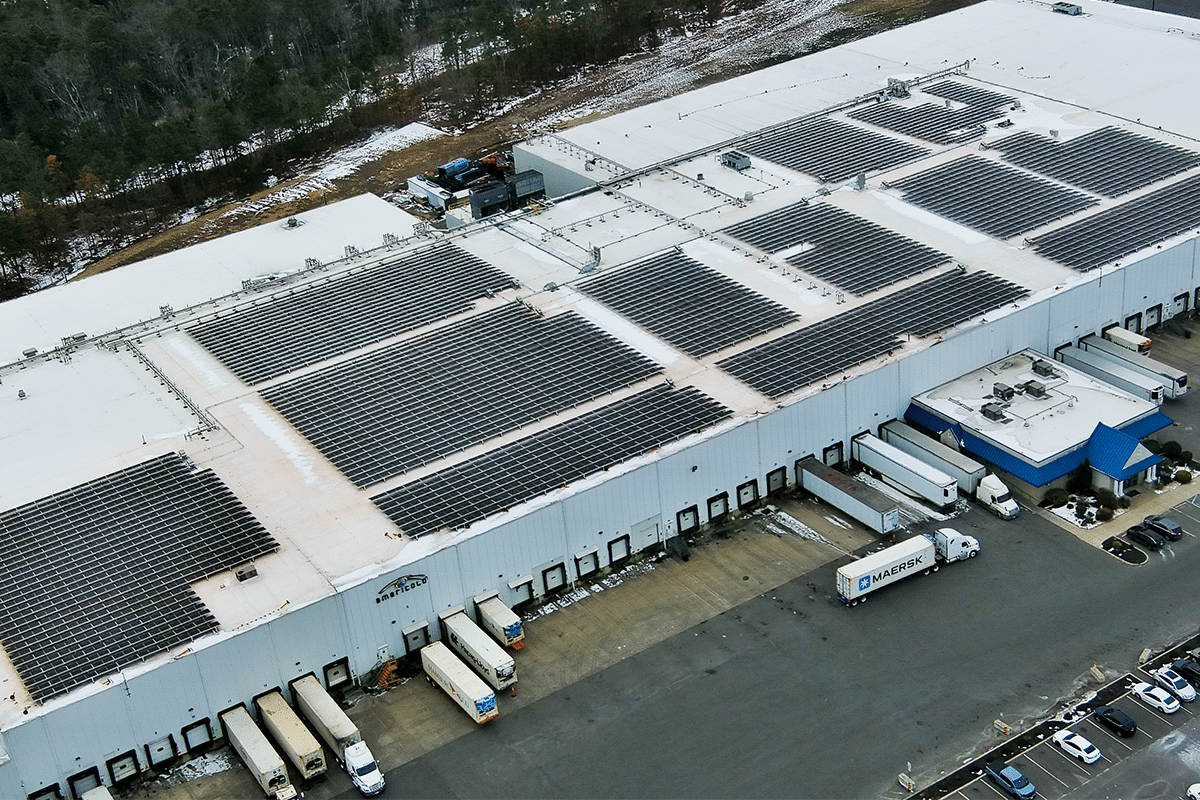
Americold Logistics in Vineland, New Jersey
Exact Solar installed a 1.31 MW DC solar system at Americold Logistics in Vineland.
Cold storage facilities often have substantial electricity needs because refrigeration equipment runs for extended periods. Solar can offset a portion of that consumption, with the potential savings depending on the facility’s usage, system production, and utility rate.
Camp Nock-a-Mixon in Kintnersville, Pennsylvania
At Camp Nock-a-Mixon in Kintnersville, Pennsylvania, Exact Solar installed solar systems across multiple buildings.
The installations include systems rated at 116 kW DC, 24.71 kW DC, and 20.66 kW DC.
This project illustrates how an organization can use several buildings within a campus to produce solar electricity.
Read about Camp Nock-a-Mixon’s solar installations.
Doylestown Borough Hall
Exact Solar installed a 167.75 kW solar system at Doylestown Borough Hall.
Municipal buildings can offer an opportunity to produce electricity on public property while helping manage long-term operating expenses.
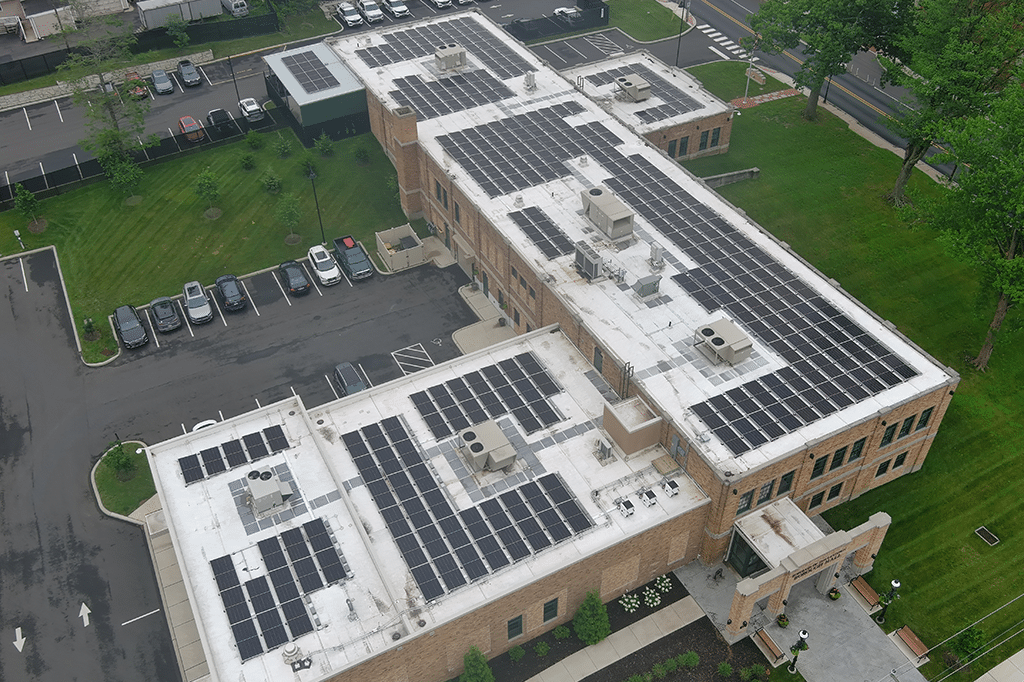
Read more about the Doylestown Borough Hall installation.
United Christian Church in Levittown
Exact Solar installed a rooftop solar array at United Christian Church in Levittown.
Reducing purchased electricity can help a congregation direct more of its budget toward community programs, building needs, and ministry. Ownership options and available incentives are important parts of evaluating that investment.
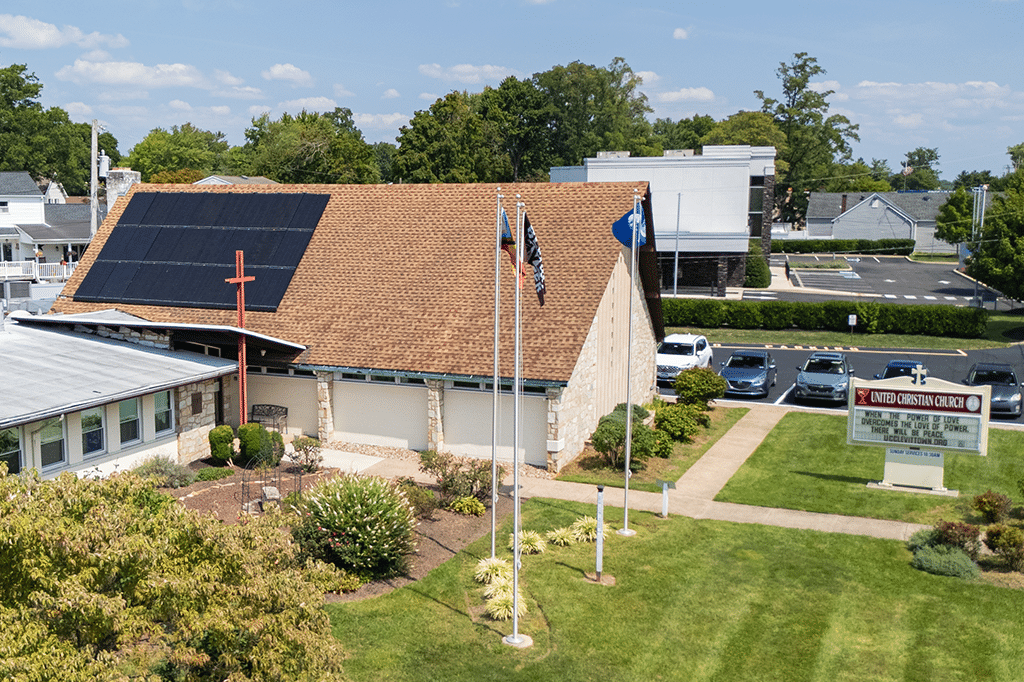
Learn about United Christian Church’s solar project.
Frequently Asked Questions About the Energy Community Solar Tax Credit
Is an Energy Community the Same as a Low-Income Community?
No. These are separate federal designations with different qualifying rules.
A project may be located in one, both, or neither. Eligibility for the energy community bonus does not automatically establish eligibility for a low-income communities bonus, which has its own application and allocation requirements.
Does Every Commercial Solar Project in Pennsylvania and New Jersey Qualify?
No. Location must be checked for the specific project, and the project must also meet the underlying tax-credit requirements.
The June 2026 statistical-area list includes several counties in Exact Solar’s service area. Other sites may qualify under the coal-closure or brownfield categories.
An address review is a useful first step, followed by verification of the applicable designation and project timing.
Should I Check Again if My Property Did Not Previously Qualify?
Yes. Statistical-area eligibility can change when the IRS updates its unemployment-based list.
A property that did not qualify during an earlier review may qualify under a later designation. Be sure to use information relevant to your project’s construction or placed-in-service date.
Can Small Commercial Solar Projects Receive the Bonus?
Yes. Qualifying smaller and midsize projects can also benefit.
Facilities with maximum net output below 1 MW AC can generally qualify for an exception to the prevailing wage and apprenticeship requirements associated with the increased credit rate.
That threshold is separate from the 1.5 MW AC threshold discussed in the construction safe-harbor rules.
Does the Energy Community Bonus Apply to Residential Solar?
The energy community bonus is not part of the homeowner Residential Clean Energy Credit.
However, saying that every eligible installation must be on a commercial building would be too broad. A business-owned system installed at a residence may be evaluated under business tax-credit rules, depending on its ownership and other circumstances.
In that situation, any credit would generally belong to the eligible system owner, rather than the homeowner purchasing electricity or leasing the equipment.
Can Nonprofits and Municipalities Receive the Energy Community Bonus?
Yes, if the organization and project meet the relevant requirements.
Elective pay may allow an eligible tax-exempt organization or government entity to receive the credit’s value as an IRS payment. Registration, filing, ownership, and any applicable domestic content requirements still need to be addressed.
Can the Energy Community and Domestic Content Bonuses Be Combined?
Yes. A qualifying project can potentially receive both.
For a project eligible for the increased credit rate, the combination can look like this:
| Qualifying project | Potential investment tax credit |
|---|---|
| Eligible for the increased credit rate | 30% |
| Also meets energy community requirements | 40% |
| Also meets domestic content requirements | 50% |
Each requirement must be supported separately. Using one U.S.-made component does not automatically establish compliance with the domestic content rules.
Your installer should address equipment sourcing during project development, and your tax advisor should review the supporting documentation.
Does an Energy Community Location Guarantee a 40% Solar Tax Credit?
No. The 40% example assumes the project qualifies for the 30% rate and the full 10-percentage-point energy community bonus.
The project must also meet applicable timing, ownership, equipment, and other eligibility requirements. Confirming the address is the beginning of the review.
Explore Solar Incentives for Your Pennsylvania or New Jersey Property
An additional incentive can make a meaningful difference in a solar proposal, but your organization still needs a clear picture of the overall investment.
That includes expected electricity production, utility savings, installation costs, available incentives, and the requirements attached to them.
Exact Solar can help you evaluate those details and understand whether solar is a good fit for your business, school, municipality, nonprofit, or house of worship in Pennsylvania or New Jersey.
Get a free estimate to explore your property’s solar potential and discuss the incentives that may apply.