
When a Pennsylvania school district considers solar, designing the system is only part of the process. Administrators also need to evaluate funding, select a contractor, coordinate construction, and follow the purchasing requirements that apply to public projects.
For Tredyffrin/Easttown School District, Pennsylvania’s COSTARS cooperative purchasing program provided a way to move forward with solar at Conestoga High School’s new athletic field house.
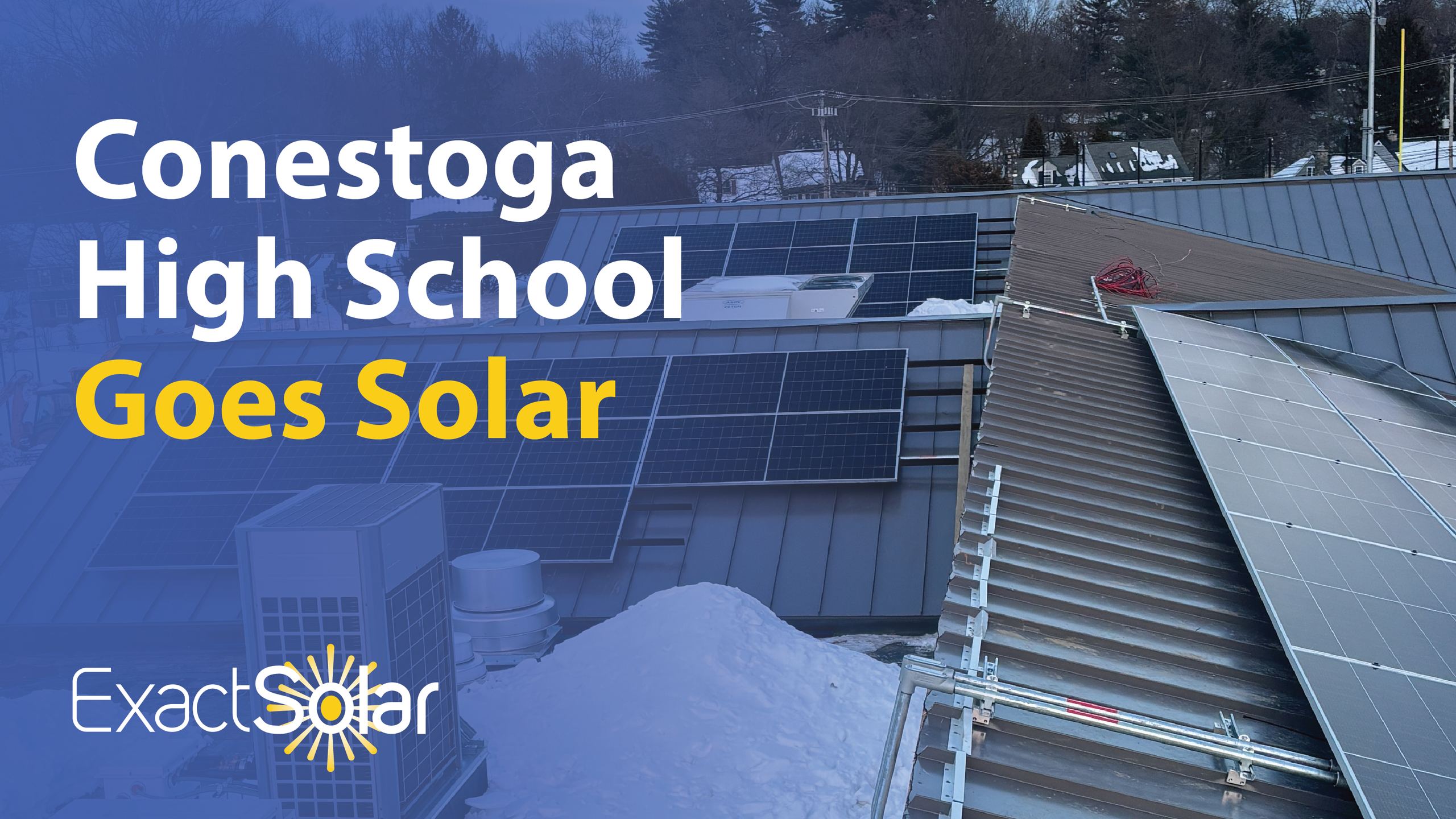
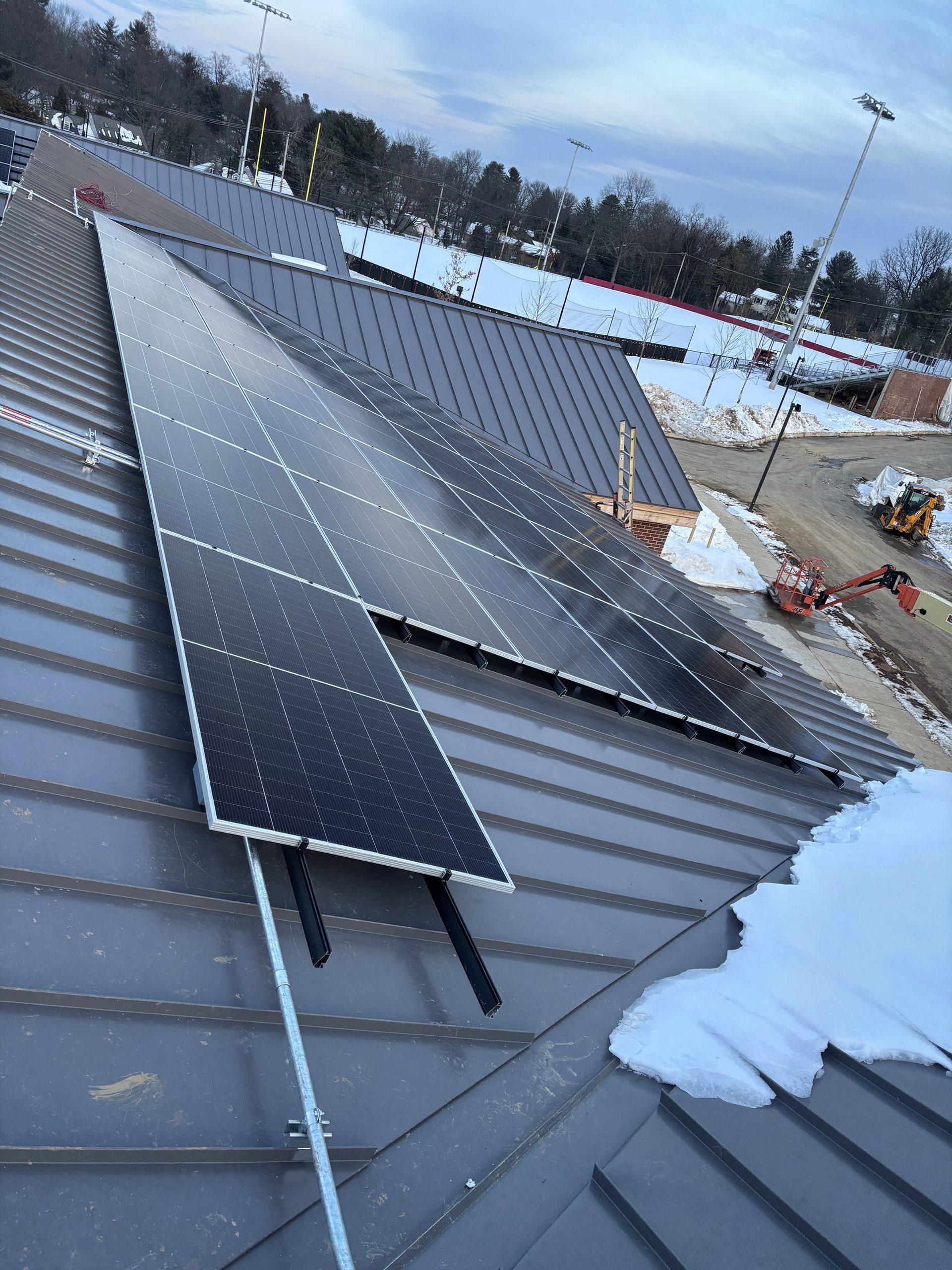
Located in Berwyn, Chester County, the installation includes 103 solar panels with a combined capacity of 59.74 kilowatts DC. Exact Solar’s in-house team designed and installed the system on the building’s standing seam metal roof.
The array is projected to produce approximately 80,080 kilowatt-hours of electricity in its first year, equivalent to about 73% of the field house’s modeled annual electricity use.
The project offers a practical example of how a school district can bring together cooperative purchasing, building design, and renewable energy planning.
Here’s how the district approached the project, what our team installed, and what other Pennsylvania schools can learn from the experience.
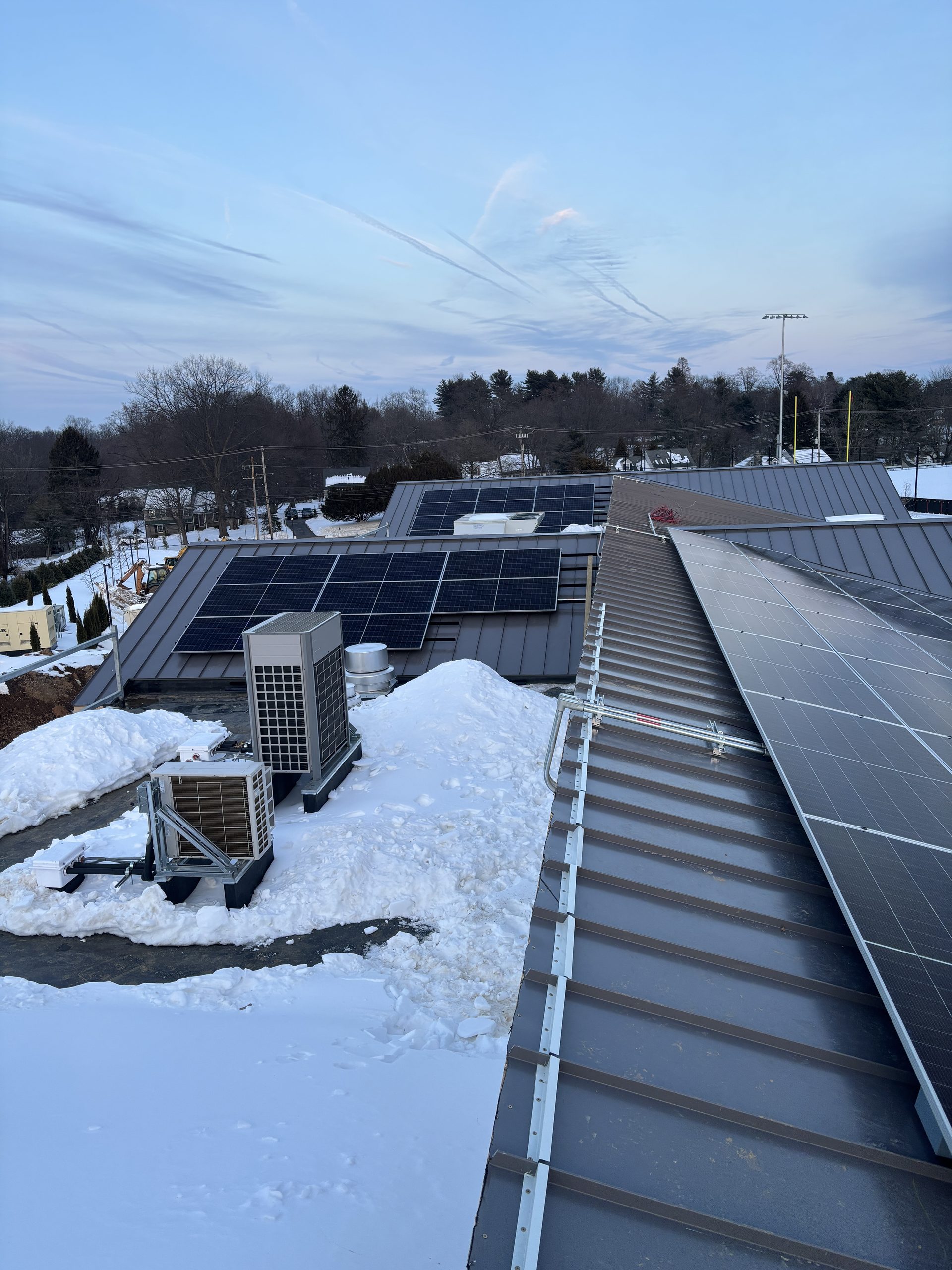
Table of Contents
How COSTARS Supported the Conestoga High School Solar Project
COSTARS is Pennsylvania’s cooperative purchasing program, administered by the Department of General Services.
It gives eligible public organizations access to awarded contracts for covered supplies and services. For qualifying purchases, this can reduce the time and administrative work involved in conducting a separate competitive solicitation.
Tredyffrin/Easttown School District used this purchasing route to work with Exact Solar on the field house installation.
For a district coordinating a larger construction project, having an established purchasing option can help move the conversation toward the details that determine whether solar is a good fit: system design, cost, expected production, installation requirements, and long-term support.
Who Can Use COSTARS?
Eligible participants include school districts, municipalities, public authorities, and certain nonprofit educational, public health, and emergency-service organizations.
Organizations must meet the program’s eligibility and registration requirements before purchasing through its contracts.
That makes COSTARS relevant to many of the community projects Exact Solar works on, including schools and other public facilities.
What Does COSTARS Supplier Status Mean?
Suppliers must register with the Commonwealth and respond to the applicable contract solicitation. A contract award allows a supplier to offer covered products and services to participating members under its terms.
Exact Solar’s COSTARS supplier status provides eligible organizations with an established route for considering our solar services.
It also gives district staff a starting point for reviewing the available scope and requesting project-specific pricing.
Schools Still Need to Review Project Requirements
Cooperative purchasing simplifies an eligible purchase, but the district still needs to confirm that the proposed work fits the contract and complies with applicable requirements.
Construction laws, prevailing-wage requirements, grant conditions, and district approvals may still apply. Pennsylvania’s Department of General Services advises public purchasers to consult their legal counsel about the appropriate use of COSTARS for a particular project.
For schools considering solar, the practical first step is to bring the facilities team, business office, and solicitor into the discussion early.
That helps establish a purchasing approach that fits both the solar installation and the district’s responsibilities.
A Solar Installation Within a Larger Athletic Fields Project
The solar panels serve the new athletic field house, rather than Conestoga High School’s main building.
The installation is part of a broader effort to improve the district’s athletic facilities and bring more activities onto campus.
In May 2021, the Tredyffrin/Easttown Board of School Directors reviewed an athletic field study addressing field availability, off-site practices, transportation costs, and related challenges.
After acquiring a former nursery property adjacent to the high school, the district developed plans for additional facilities.
The athletic fields project included two turf fields, a practice field, a softball diamond, batting cages, tennis courts, portable bleachers, parking, and the field house.
Solar gave the district an opportunity to put the new building’s roof to work generating electricity.
Planning for Solar and Exploring Funding
The district’s January 2025 board minutes document authorization for a solar facility site assessment for the field house. The assessment was intended to support a Solar for Schools grant application and included shade analysis, maintenance planning, and grant assistance.
That record illustrates the preparation involved in evaluating a school solar project. A grant application, however, should be distinguished from an approved award.
The district’s 2025–2026 Goal Completion Report subsequently identified the installed field house solar panels among its sustainability measures.
Conestoga High School Solar Project at a Glance
Exact Solar’s in-house team completed the installation in March 2026.
| Project detail | Specification |
|---|---|
| School district | Tredyffrin/Easttown School District |
| Location | Conestoga High School athletic field house, Berwyn, Pennsylvania |
| Utility | PECO |
| Solar array capacity | 59.74 kW DC |
| Inverter capacity | 40.00 kW AC |
| Solar panels | 103 ZNShine ZXM7-UHLDD144-580 modules, rated at 580 watts each |
| Inverter | One SolarEdge SE40K-US, 480-volt three-phase |
| Power optimizers | 103 SolarEdge U650 optimizers, one per module |
| Racking | IronRidge XR100 rails |
| Roof attachment | S-5! standing seam clamps |
| Design and installation | Exact Solar’s in-house team |
| Installation completed | March 2026 |
| Projected first-year production | Approximately 80,080 kWh |
| Projected annual electricity offset | Approximately 73% of the field house’s modeled use |
What Do the DC and AC Ratings Mean?
Solar panels produce direct-current electricity, or DC. The inverter converts that electricity into alternating current, or AC, for use by the building.
The two capacity figures describe different parts of the system. They should not be added together.
Similarly, kilowatts describe power capacity, while kilowatt-hours describe electricity produced over time. The projected 80,080 kWh is the annual energy estimate used to evaluate the system’s contribution.
Installing Solar on a New Standing Seam Metal Roof
A new roof is a significant investment. Adding solar requires careful coordination between the array design, attachment hardware, and roofing system.
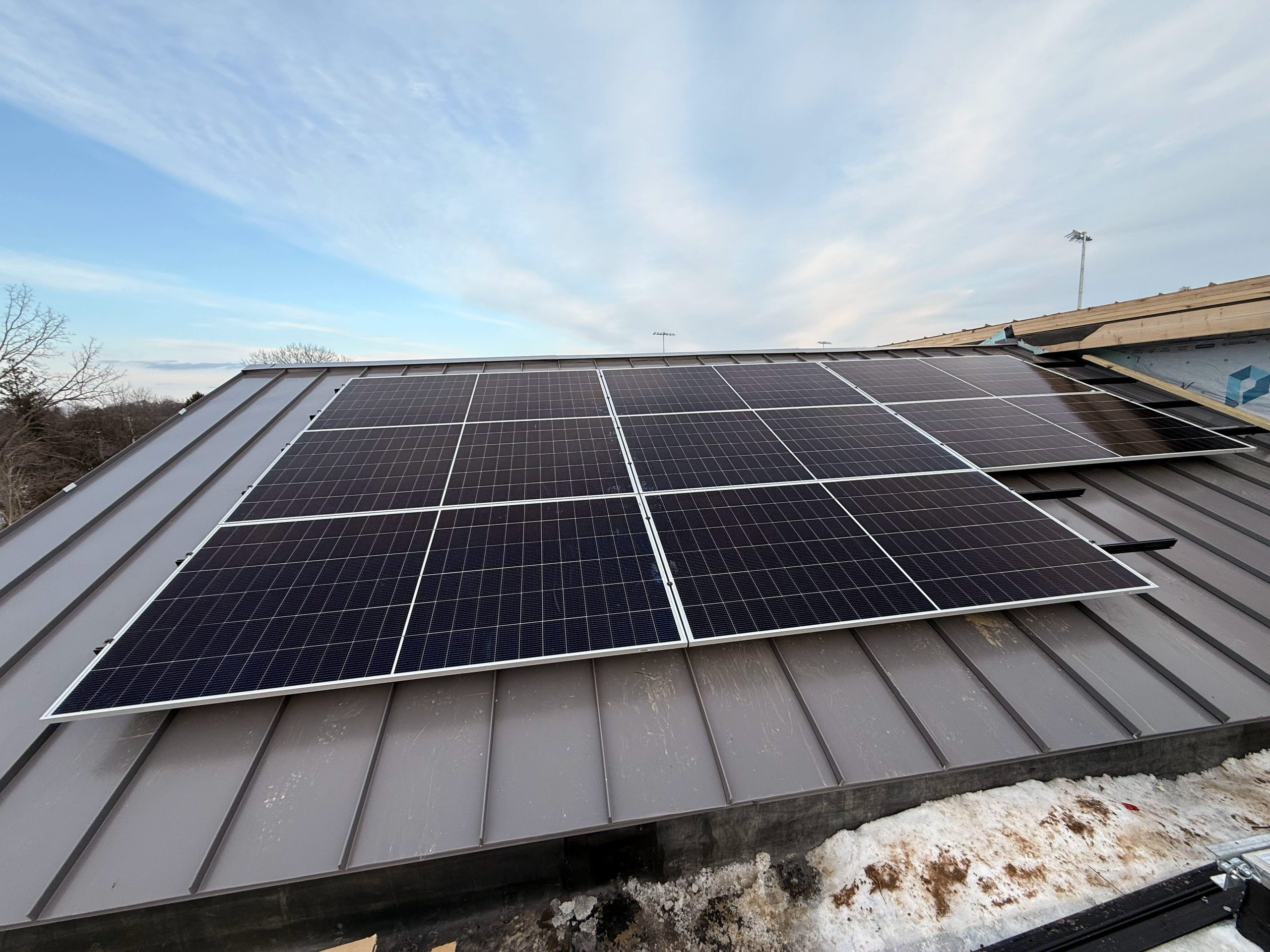
For Conestoga’s field house, the standing seam metal roof allowed our team to use clamps that attach to the raised seams without drilling through the roofing panels.
Standing seam roofs consist of metal panels joined along raised seams. Compatible solar mounting hardware can grip those seams, creating attachment points for the array.
This approach can be particularly useful when a district wants to add solar while limiting penetrations through a new roof.
How the Mounting System Works
The field house installation uses several components that work together:
- S-5! clamps attach to the standing seams. They secure the mounting system to the roof without penetrating the metal panels.
- L-feet connect the clamps to the rail system. These brackets provide attachment points for the rails.
- IronRidge XR100 rails support the array. The rails provide the structure on which the panels are mounted.
- IronRidge UFO clamps secure the panels to the rails. These hold the modules in position.
The result is a roof-mounted array secured through the standing seams.
Why Roof-Specific Design Matters
A standing seam roof can be well suited to solar, but the attachment still needs to match the roof profile and project requirements.
Clamp selection, fastening procedures, structural capacity, and wind and snow loads all matter. Roof-manufacturer requirements and warranty conditions should also be reviewed.
Avoiding roof penetrations is a useful design feature. Careful engineering and installation are what make that feature work as intended.
For a school district, these details are part of protecting the building while adding an asset expected to serve the community for many years.
How Much Electricity Will the Field House Solar System Produce?
Exact Solar projects approximately 80,080 kWh of electricity in the system’s first year.
That is equivalent to roughly 73% of the field house’s modeled annual electricity consumption.
The percentage applies to the field house—not the entire high school or school district. It is also an annual comparison, rather than a statement that solar supplies 73% of the building’s needs at every moment.
Production changes with sunlight, weather, and seasonal conditions. Building electricity use also varies throughout the year.
As operating data accumulates, the district can compare actual generation and consumption with the original estimates.
Putting the Environmental Benefits in Perspective
Using the EPA’s published national avoided-electricity emissions factor, the projected first-year production corresponds to approximately 54 metric tons of avoided carbon dioxide emissions.
That is roughly comparable to:
- The annual greenhouse gas emissions of 13 gasoline-powered passenger vehicles.
- The carbon-sequestration equivalent of approximately 900 urban tree seedlings grown for 10 years, using the EPA calculator’s comparison.
- The emissions avoided by recycling approximately 19 U.S. tons of mixed materials instead of landfilling them.
These are alternative illustrations of the same estimated benefit; they should not be added together.
The EPA’s calculation methods provide context for these comparisons. They are estimates rather than direct measurements of emissions at the school.
Understanding the Long-Term Impact
To illustrate the scale over 30 years, multiplying the rounded first-year figures by 30 gives approximately:
| Measure | Simple 30-year illustration |
|---|---|
| Electricity generation, using first-year output each year | 2.4 million kWh |
| Avoided carbon dioxide, using the rounded annual estimate | 1,620 metric tons |
| Equivalent urban tree seedlings grown for 10 years | 27,000 |
| Equivalent mixed materials recycled instead of landfilled | 570 U.S. tons |
This is a simple illustration, not a detailed lifetime forecast. Actual results will depend on panel degradation, weather, system availability, and changes in the electricity grid’s emissions over time.
The long-term opportunity is substantial: a roof that supports the building can also produce useful electricity year after year.
The Experience Behind Exact Solar’s School Projects
School projects involve facilities staff, administrators, board members, and the surrounding community. Each group needs clear information about the project’s cost, expected performance, construction, and ongoing support.
Exact Solar’s role is to help those stakeholders understand the proposal and deliver the installation described.
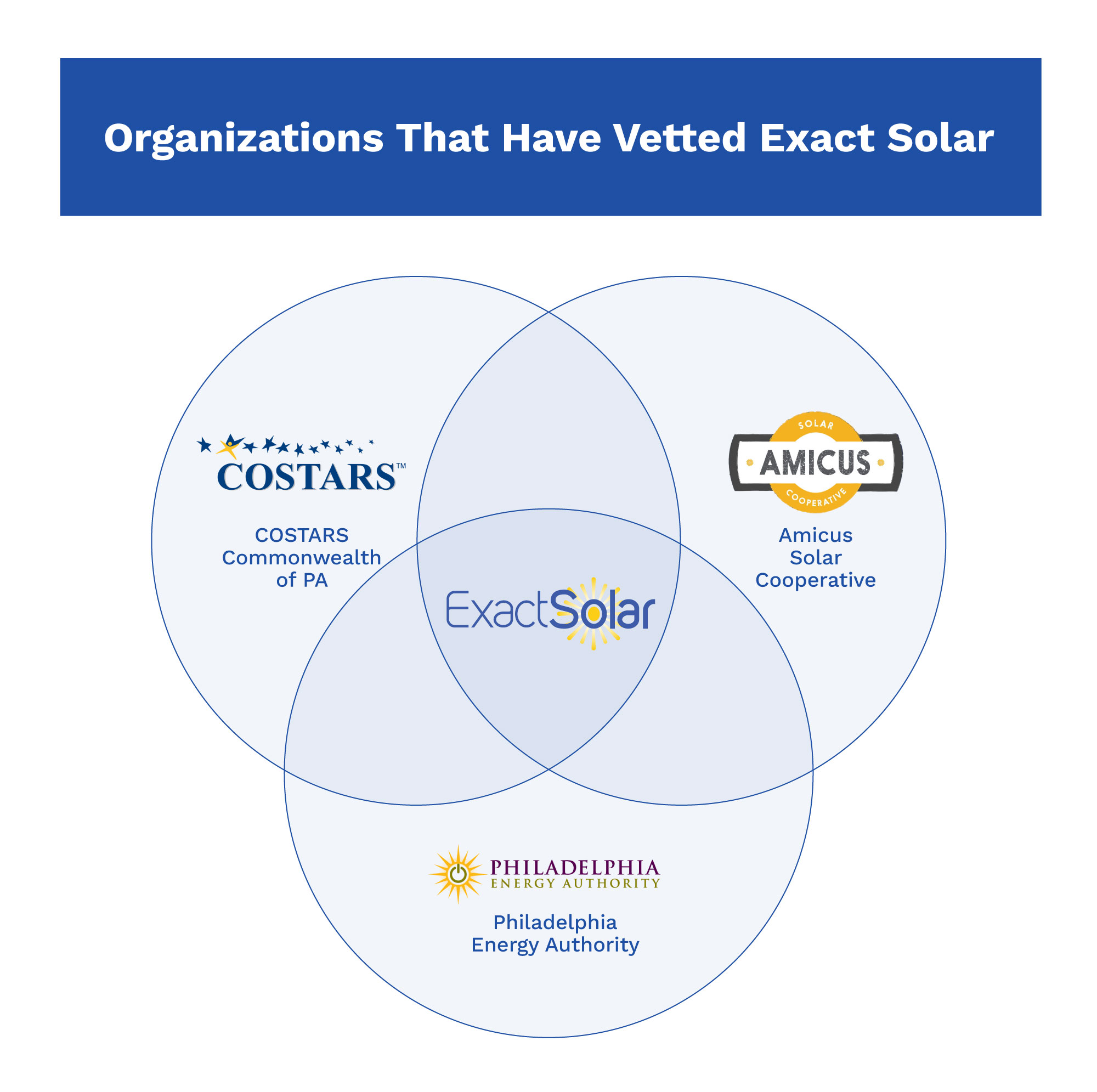
Our participation in COSTARS, Amicus Solar Cooperative, and Solarize Greater Philadelphia provides additional context for organizations evaluating our team. Each has a different purpose and review process.
COSTARS Supplier
Our COSTARS supplier status gives eligible public organizations a cooperative-purchasing option for covered work.
Districts can review the applicable contract alongside their own project requirements and approval process.
Amicus Solar Cooperative Member
Amicus Solar Cooperative is a member-owned network of independent solar companies.
Its membership review considers operating experience, financial strength, customer and industry reputation, and installation quality.
Participation also connects Exact Solar with other experienced installers who share knowledge about design, operations, and customer service.
Solarize Greater Philadelphia Installer
Exact Solar is an approved residential installer for Solarize Greater Philadelphia.
The program’s installer review considers pricing, technical capability, customer service, and financial stability.
This is a separate program from the Conestoga project. It offers another example of an external review of our company’s qualifications.
Tredyffrin/Easttown Is Evaluating Additional Solar Work
During the field house project, the district contacted Dave Hammes, the Exact Solar commercial sales engineer working on the installation, to confirm our continued COSTARS supplier status.
The district also requested pricing for potential solar installations on additional buildings under construction.
At the time this case study was prepared, Exact Solar had submitted a proposal, with any additional work subject to School Board approval.
The proposed work remains separate from the completed field house installation. Its scope and schedule depend on the district’s decisions and project requirements.
We appreciate the opportunity to continue that conversation and help the district evaluate where additional solar may make sense.
What Other Pennsylvania Schools Can Learn From This Project
Conestoga’s field house shows how a school can incorporate solar into a broader facilities plan.
It also highlights the value of addressing purchasing, funding, roof conditions, and expected energy use together.
Exact Solar has worked with other Pennsylvania schools, including Holland Middle School, Sandy Run Middle School, and ASPIRA Bilingual Cyber Charter School.
Those projects serve different buildings and educational goals. A useful solar plan begins with the needs of the individual school.
Review the Building and Electricity Use
Start with the available roof or land, structural conditions, planned construction, and electricity consumption.
For a new building, projections depend on modeled usage. For an existing building, utility records provide a basis for evaluating system size and potential savings.
Establish the Purchasing Approach Early
COSTARS may provide an appropriate route for eligible purchases. Other projects may use a separate solicitation or another authorized process.
The district’s business office and solicitor should confirm the approach, particularly when construction work or grant funding introduces additional requirements.
Evaluate Funding and Incentives
Pennsylvania schools may have several options to investigate:
- Solar for Schools grants: The state program can help eligible schools fund qualifying solar projects. Awards depend on the applicable guidelines, available funding, and selection process.
- Federal elective pay: Eligible public and tax-exempt entities may receive payment for qualifying clean-energy tax credits after meeting the relevant requirements. Read Exact Solar’s guide to elective pay for tax-exempt organizations.
- Energy community bonus: A qualifying investment-credit project may receive an additional 10 percentage points when it meets both energy-community eligibility and the requirements for the increased credit rate. Other eligible projects may receive a smaller bonus.
These options require project-specific review. An energy-community map is a starting point for evaluating location eligibility, and it does not establish that every school in a service area qualifies.
Funding and tax-credit rules also change. Schools should confirm current requirements, deadlines, and the interaction between funding sources before relying on an incentive in the project budget.
Plan for Long-Term Use
A school solar project should include a clear understanding of monitoring, maintenance, warranties, and responsibility for service.
There may also be opportunities to use the installation in lessons about electricity, engineering, and sustainability.
A visible project on a familiar school building can help students connect those subjects with infrastructure in their own community.
Talk With Exact Solar About Your School’s Solar Project
No two school projects have the same roof, electricity use, budget, or construction schedule.
Exact Solar can help your team evaluate those details and develop a proposal that explains the expected production, project scope, purchasing options, and potential funding.
Whether your district is planning a new building or considering solar on an existing facility, a conversation is a useful place to start.
Schedule a free solar consultation to discuss your school or district.
Connect With Our Commercial Team
Dave Hammes worked with Tredyffrin/Easttown School District on the Conestoga field house project.
He brings more than 20 years of solar-industry experience, including executive roles developing projects in the United States, Africa, and Latin America.
His background includes contributing to more than 100 megawatts of solar installations while serving as a vice president for a solar module manufacturer. He has also presented at the United Nations General Assembly on solar applications for water pumping, agriculture, and drinking water.
Dave can help school leaders begin evaluating the practical questions behind a solar project, from site suitability to project development.

Dave Hammes
Commercial Sales Engineer
📞 (267) 454-1562
✉️ [email protected]
Production and electricity-offset figures are project estimates, not measured annual results. Environmental comparisons are illustrative. Procurement requirements, incentive programs, and project status may change. This article is educational and does not provide legal or tax advice; districts should confirm applicable requirements with their professional advisers.