
If you own or manage a business with high electricity costs, pull out your latest electric bill. Somewhere on that bill, you may see a line that says “demand,” “capacity,” “peak demand,” “billing demand,” or “maximum demand.”
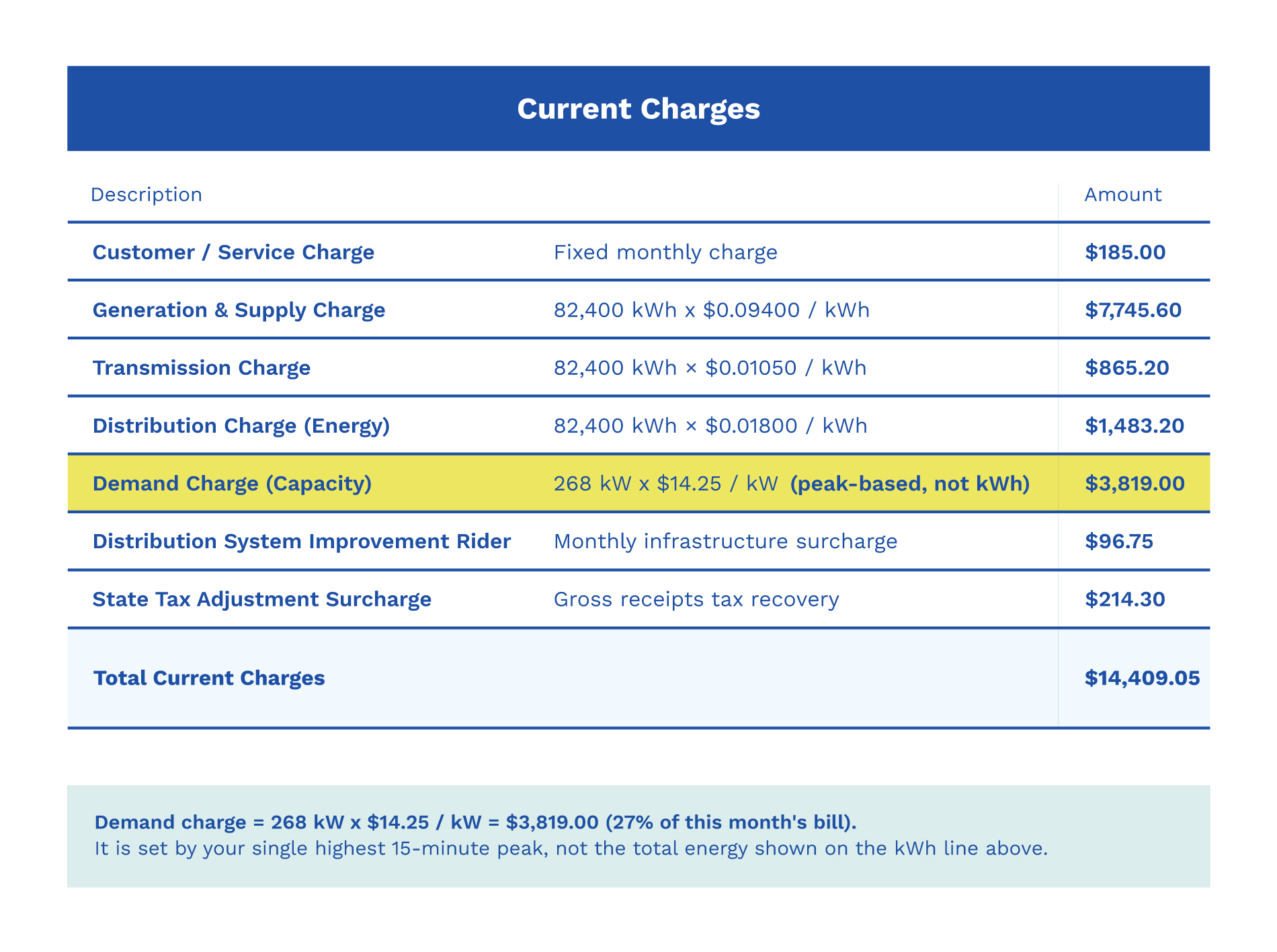
For many businesses Exact Solar has worked with, demand-related charges account for 30 to 70 percent of the total electric bill. These charges are separate from the amount you pay for the total electricity your business consumes. Instead, they are based on how much power your building draws from the grid during its highest measured period of the month.
Depending on your utility company and rate schedule, the charge may look something like this:
Demand charges are one of the most expensive and most confusing parts of a commercial electric bill.
Once you understand what creates them, however, demand charges can also become one of the most actionable parts of your business’s energy costs.
This guide explains how demand charges work, how utility companies calculate them, and how solar and commercial battery storage can reduce peak demand.
Important: Exact Solar is not a tax, legal, or accounting firm. Tax credit, depreciation, and incentive information in this article is provided for general educational purposes only and may change. Eligibility depends on your specific project and tax situation. Please consult a qualified tax professional before making financial decisions.
Table of Contents
What Is a Commercial Demand Charge?
To understand demand charges, you need to understand the difference between power and energy.
Power is the rate at which your business is using electricity at a given time. On a commercial electric bill, it is usually measured in kilowatts, or kW. Energy is the total amount of electricity your business uses over time. It is usually measured in kilowatt-hours, or kWh.
For example, imagine a piece of equipment that requires 100 kW of power while it is operating. If that equipment runs continuously for two hours, it consumes 200 kWh of energy.
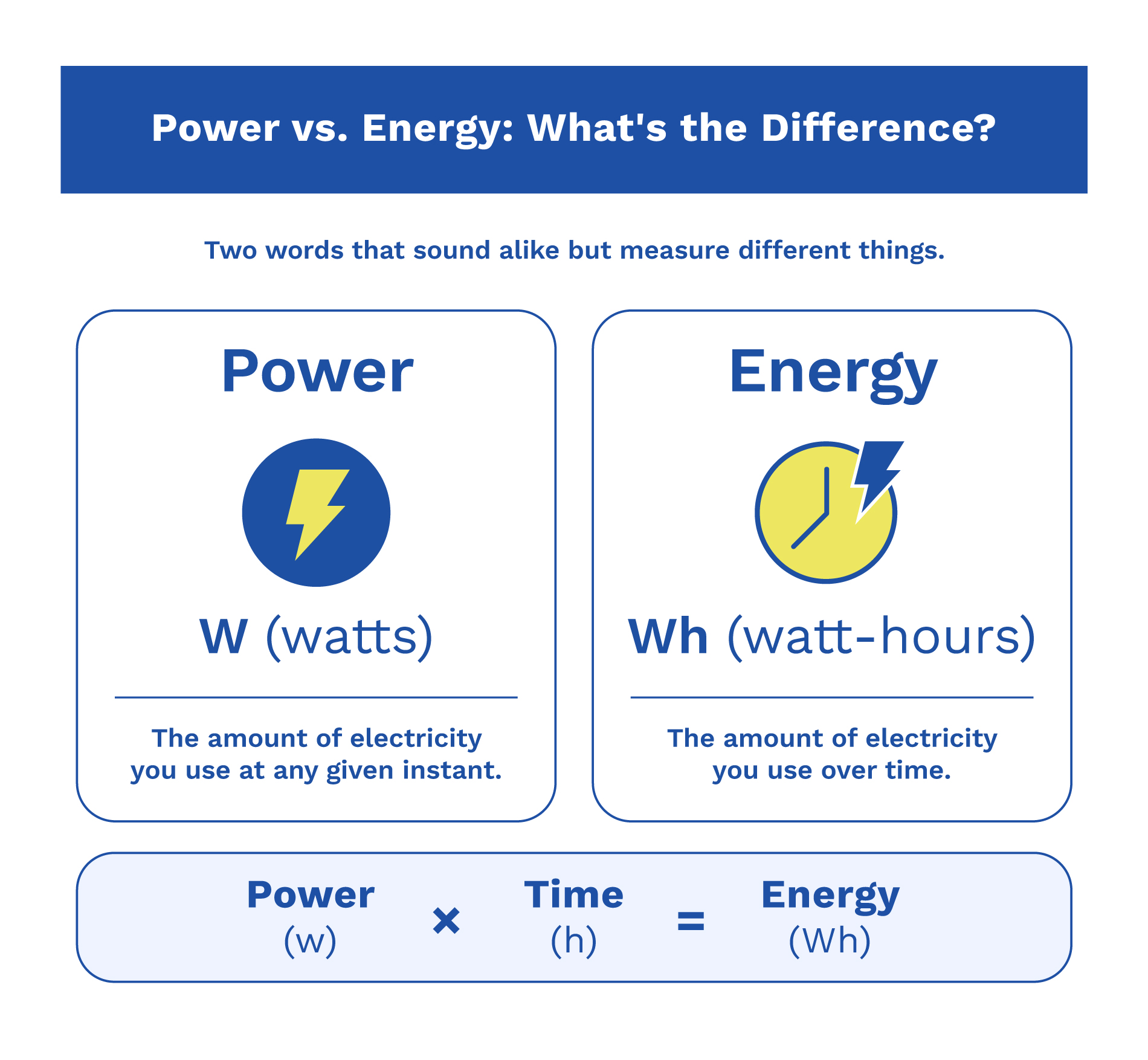
A demand charge is a fee based on your business’s highest average rate of electricity use during a defined measurement interval. It is separate from the charge for the total amount of energy your business consumed throughout the month.
Here is the difference in simple terms:
Energy charge: This is based on the total amount of electricity your business consumes during the billing period. It is measured in kilowatt-hours, or kWh.
Demand charge: This is based on the highest average amount of power your business draws during the utility’s measurement interval. It is measured in kilowatts, or kW.
Utilities commonly measure demand in intervals of 15, 30, or 60 minutes. This means a very brief startup surge may not determine your demand charge. A sustained period of high electricity use is more likely to establish your peak.
Using Water to Explain Power and Energy
Instead of using electricity, we can imagine water flowing through a hose to explain this concept:
- The energy charge bills you for the total number of gallons that flow through your hose over the month.
- The demand charge bills you based on the highest rate at which water needed to flow during a measured period.
- Imagine turning on all your sprinklers, filling a pool, and washing several vehicles at the same time. Even if you only needed that much water briefly, the system still had to provide enough capacity to handle the unusually high flow.
In the same way, an electric utility must maintain enough generation, transmission, distribution, transformer, and substation capacity to serve your business during its highest-use periods, even if your electricity use is much lower during the rest of the month.
Why Do Demand Charges Exist?
Electric utilities must continuously balance the amount of electricity being generated with the amount customers are using. Grid-scale battery storage is becoming more common, but utilities still need enough generation and delivery infrastructure to meet periods of unusually high demand.
To make sure power is available when businesses and households need it most, utilities invest in equipment such as:
- Power plants and other generation resources
- Transmission lines
- Local distribution lines
- Substations
- Transformers
- Grid controls and monitoring systems
- Utility-scale energy storage
Some of that infrastructure operates below its full capacity during normal conditions, but it still needs to be available during the relatively small number of hours when electricity demand is especially high.
Demand charges help the utility pay for the infrastructure required to meet those peaks. Commercial customers that create greater or more concentrated demands may therefore pay more than businesses that use the same total amount of energy at a steadier rate.
A business with a sharp, sudden spike can place more demand on the grid than one that uses the same amount of energy in a smooth, steady pattern.
A brief motor or air-conditioner startup surge may be too short to establish a business’s measured peak by itself. The larger concern is often what happens when several major loads operate throughout the same demand interval.
For example, a business may establish a new peak when:
- Several HVAC units operate at full capacity
- Multiple refrigeration compressors cycle on together
- Commercial ovens and kitchen equipment run at the same time
- Manufacturing equipment operates simultaneously
- Pumps, motors, or processing equipment overlap
- An electric vehicle fleet begins charging all at once
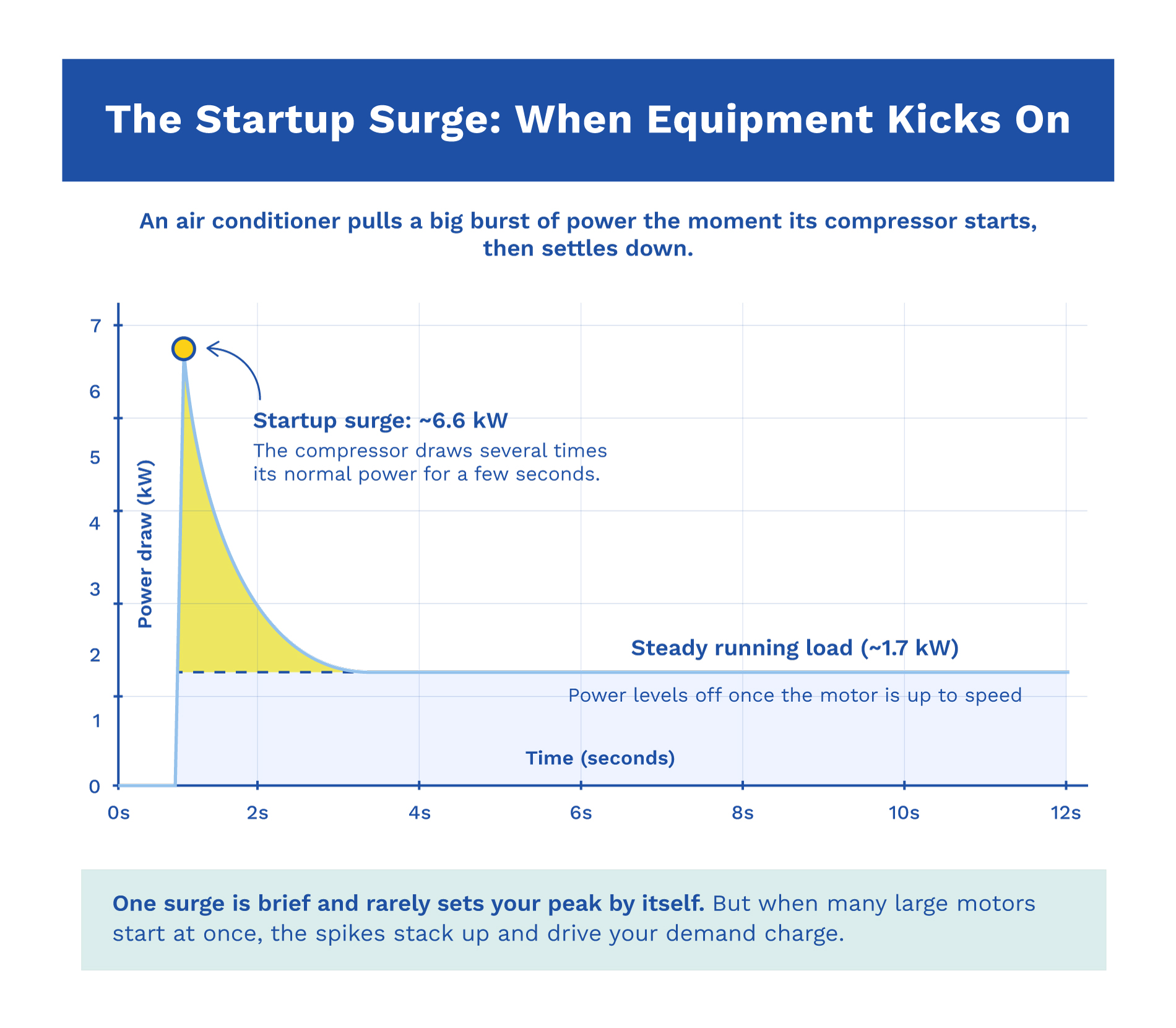
The business may use electricity efficiently during most of the month, but if several large loads remain active during the same 15-, 30-, or 60-minute interval, that period could establish the billing demand for the entire month.
How Utilities Calculate Commercial Demand Charges
Your meter does more than track total energy consumption. For many business accounts, it also records average demand in short blocks of time throughout the billing period.
The interval may be 15, 30, or 60 minutes, depending on your utility company and rate schedule. At the end of the billing period, the utility identifies the interval in which your business had its highest average power demand.
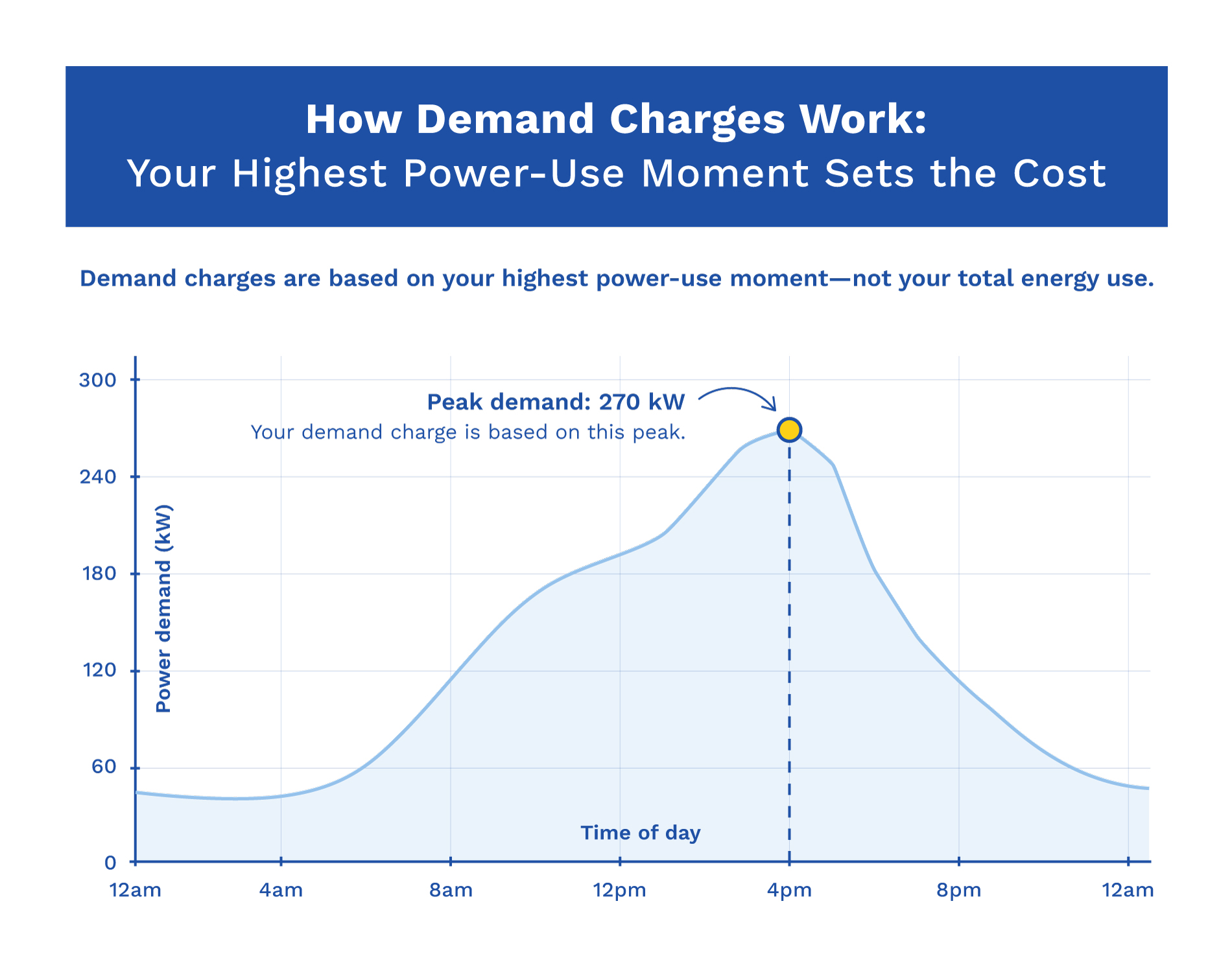
The basic calculation is:
Demand Charge = Billing Demand in kW × Demand Rate in Dollars per kW
Your measured peak is the highest average amount of power you drew during one of the utility’s demand intervals. The demand rate is the utility’s price per kilowatt. Demand rates vary substantially based on the utility company, rate class, season, location, service voltage, and other tariff rules.
A Simple Demand-Charge Example
Suppose your business has:
- A measured demand of 200 kW
- A demand rate of $15 per kW
Your demand charge would be:
200 kW × $15 per kW = $3,000
That $3,000 would be separate from the charges for the total kilowatt-hours your business consumed.
Because demand is calculated as an average over an interval, a spike lasting only a few seconds may have little effect on your bill. However, if a large machine operates throughout the interval, or several major loads run during the same period, that interval may establish your monthly peak.
Depending on your rate schedule, your business may then be billed based on that highest interval even if its demand was much lower during the rest of the month.
Measured Demand and Billing Demand May Be Different
The highest demand recorded by your meter is not always the final number used to calculate your bill.
Some commercial utility rates include a demand ratchet or look-back period. Under that structure, your billing demand may be based on the greater of:
- Your current month’s peak
- A percentage of your highest demand during previous months
For example, a rate might bill your business based on at least 80 percent of its highest demand from the previous 11 months. A large peak in July could then continue affecting your bill during months when your business uses much less power.
Commercial tariffs may also include separate charges for:
- On-peak demand
- Off-peak demand
- Distribution demand
- Transmission demand
- Capacity
- Contract demand
- Minimum billing demand
- Your facility’s use during the larger utility system’s peak
The Department of Energy notes that demand-charge ratchets may consider both the current month and previous monthly peaks, meaning one unusual spike can continue affecting bills for much of the following year.
This is why a responsible commercial energy analysis should include the business’s complete utility rate schedule, rather than relying only on the total shown at the bottom of the bill.
Why Different Businesses Can Have Very Different Electric Bills
The easiest way to see how this works is to compare two fictional businesses that use the exact same amount of energy, but in very different ways.
These examples are simplified and do not include taxes, fixed customer charges, riders, power-factor charges, or other utility fees.
Company 1: A Concert Venue
The venue uses 60,000 kWh for the month. Its lights, sound equipment, projectors, HVAC systems, and concessions all run at once during shows. That drives its peak up to 300 kW during one demand interval.
Demand charge:
300 kW × $10 per kW = $3,000
Energy charge:
60,000 kWh × $0.12 per kWh = $7,200
Illustrative total:
$3,000 + $7,200 = $10,200
Company 2: A Cold-Storage Warehouse
The warehouse also uses 60,000 kWh during the month. Its refrigeration equipment runs at a slow, steady rate throughout the day, and its controls help prevent too many large loads from operating at once.
Its peak stays at 100 kW.
Demand charge:
100 kW × $10 per kW = $1,000
Energy charge:
60,000 kWh × $0.12 per kWh = $7,200
Illustrative total:
$1,000 + $7,200 = $8,200
Both businesses use the exact same amount of energy for the month, but the concert venue pays $2,000 more because it draws significantly more power during its highest-use interval.
Over the course of a year, the concert venue would pay approximately $24,000 more than the cold-storage warehouse.
Over the course of a decade, the concert venue could pay nearly a quarter of a million dollars more to consume the same amount of energy, before accounting for future utility-rate increases.
This is the big opportunity that solar and batteries offer to businesses. If your business can reduce its highest peaks, it may be able to lower its electric bill without reducing production, cutting operating hours, or compromising customer service.
How Commercial Battery Storage Reduces Demand Charges
A properly sized and programmed commercial battery can help flatten your building’s grid-demand curve through a strategy called peak shaving.
The battery’s control system monitors how much power your business is drawing from the utility.
When grid demand begins approaching a predetermined limit, the battery starts discharging. Your building continues receiving the electricity it needs, but part of that power comes from the battery instead of the utility. As a result, the electric meter records a lower level of grid demand.
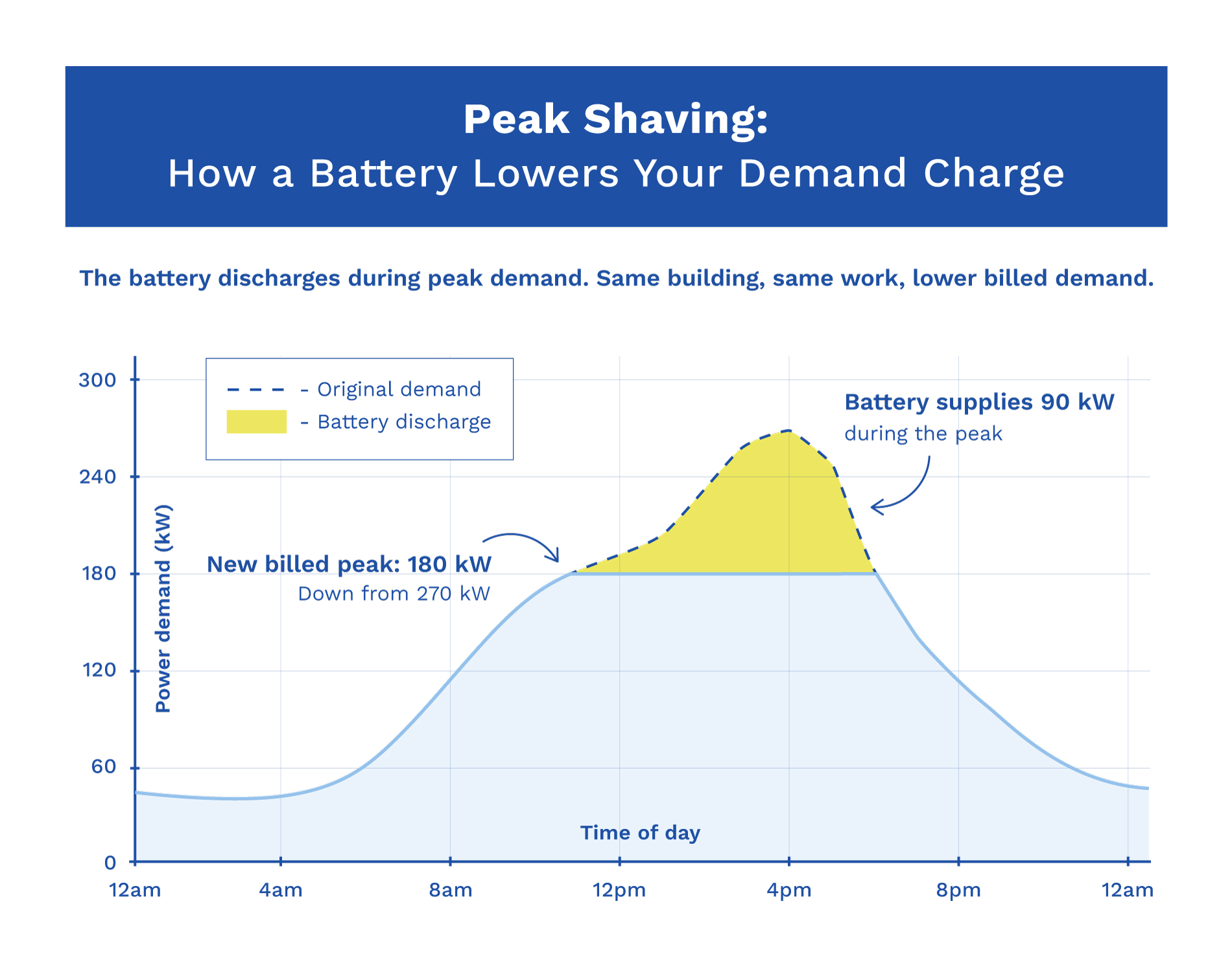
At a demand rate of $15 per kW, reducing billed demand from 270 kW to 180 kW would lower the demand charge from $4,050 to $2,700 in this simplified example. That is a difference of $1,350 per month, or approximately $16,200 per year if the same reduction were maintained each month.
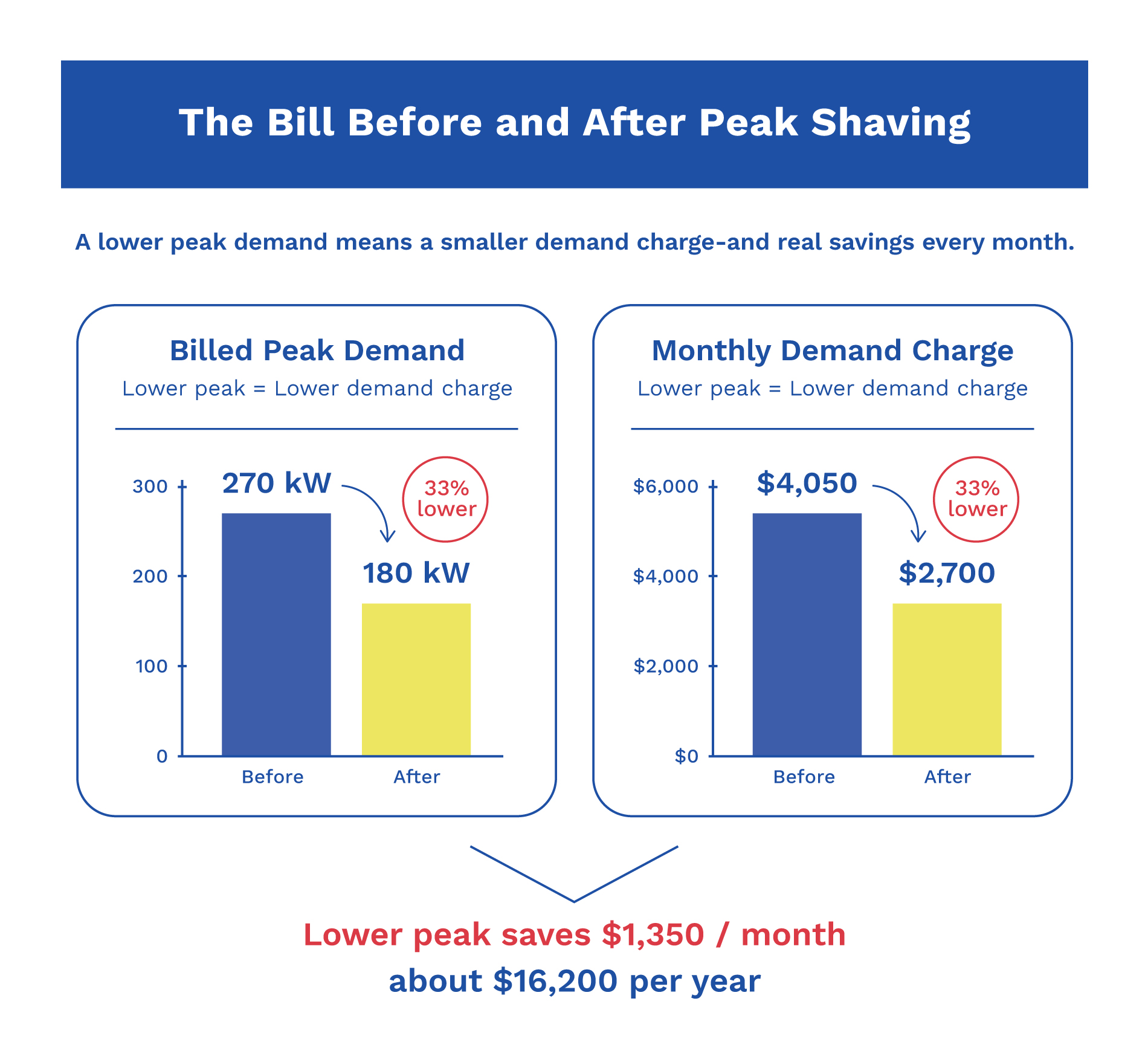
The Department of Energy identifies peak shaving as one of the primary ways battery systems can help customers reduce utility costs.
Batteries Are Sized in Both kW and kWh
A battery is sized two ways, and both matter for peak shaving:
Power capacity, measured in kW: This is how much power the battery can deliver at one time. It determines how much of a peak the battery can shave.
To reduce a peak by 80 kW, the battery must be capable of delivering at least 80 kW during the relevant period.
Energy capacity, measured in kWh: This is how much electricity the battery can store. It determines how long the battery can continue supporting the building before reaching its minimum state of charge.
A Simple Commercial Battery-Sizing Example
Say your building regularly peaks at 250 kW, and you want to limit the amount drawn from the grid to 180 kW.
The battery must supply:
250 kW − 180 kW = 70 kW of power
If your high-demand periods last approximately two hours, the basic energy calculation would be:
70 kW × 2 hours = 140 kWh of usable storage
At a minimum, the battery would therefore need approximately:
- 70 kW of power output
- 140 kWh of usable energy storage
If the battery cannot deliver enough power, it may be unable to reduce the peak to the desired level. If it does not store enough energy, it may reach its minimum state of charge before the high-demand period ends. The utility could then record a higher peak despite the battery’s earlier discharge.
A real commercial battery design also needs to account for:
- Charging and discharging losses
- Usable capacity versus nameplate capacity
- Minimum state-of-charge requirements
- Battery degradation over time
- Multiple high-demand periods in one day
- Seasonal changes in the business’s load
- Unusually long or high peaks
- Backup-power reserves
- Future equipment additions
- Future electric vehicle charging
- The availability of solar energy for charging
Accurate sizing and programming are essential to producing the savings shown in a commercial battery proposal.
The battery’s operating strategy matters just as much as its physical size. A battery may have enough capacity but still perform poorly if it discharges before the actual peak, charges at the wrong time, or fails to preserve enough energy for a later high-demand interval.
Business owners should not be expected to complete these calculations on their own. Exact Solar reviews your utility bills, interval data, rate schedule, operating hours, equipment loads, and future plans before recommending a commercial battery system.
We will explain where your peaks come from, how a battery would respond, and whether the projected savings justify the investment.
How Time-of-Use Rates Affect Business Energy Costs
Many businesses are also on time-of-use rates. That means the price of electricity changes depending on the time of day.
- Electricity may cost more during busy periods, often on weekday afternoons or early evenings.
- Electricity may cost less overnight, on weekends, or during other off-peak periods.
Some commercial rate schedules also have different demand charges during on-peak and off-peak periods.
This can create two separate costs for a business:
- A demand charge based on how much power the business draws during its highest interval
- An energy charge based on when the business consumes its kilowatt-hours
The same battery used for peak shaving may also help shift electricity use away from more expensive periods. Depending on the rate structure and system design, the battery can charge when electricity is less expensive or when solar production is available, then discharge when utility prices are higher.
Using stored electricity during high-priced periods is often called load shifting or energy arbitrage. The Department of Energy identifies both peak shaving and load shifting as common battery applications.
However, these goals must be coordinated carefully.
A battery that discharges completely to avoid an expensive time-of-use rate may not have enough energy left to prevent a later demand peak. A properly programmed system must determine when stored electricity will create the greatest value while maintaining any required backup-power reserve.
Where Commercial Solar Helps
Solar panels are highly effective at reducing the total amount of energy your business purchases from the utility. When the solar energy system is producing electricity, your building uses that electricity before drawing additional power from the grid.
Solar can also reduce demand charges when its production overlaps with your business’s highest-use interval. However, it cannot always provide the same level of predictable peak control as a properly sized battery.
A solar energy system’s output changes throughout the day. It ramps up in the morning, reaches its highest production around midday, and declines later in the afternoon.
Production also changes based on:
- Cloud cover
- Season
- Shading
- Roof orientation
- System design
- The angle of the sun
A solar energy system can still generate electricity under cloudy conditions, but its production may be significantly lower than it would be under strong sunlight.
Your demand charge may be determined by one high interval during the month. Solar can reduce that peak only if meaningful solar production occurs during the same period.
Because neither the weather nor the exact timing of every future peak can be guaranteed, demand-charge savings from solar alone should be modeled conservatively.
Solar Works Best for Businesses That Peak During the Day
Some buildings consistently reach their highest demand during sunny daytime hours.
Examples may include:
- Schools
- Offices
- Municipal buildings
- Manufacturing facilities
- Warehouses
- Retail buildings with daytime hours
- Agricultural facilities
- Refrigerated buildings with strong daytime loads
Solar may reduce demand particularly well when the building’s peak coincides with strong solar production. Other businesses may peak later in the afternoon, during the evening, or after sunset.
Examples may include:
- Hotels
- Restaurants
- Entertainment venues
- Event facilities
- Gyms
- Retail businesses with evening hours
- Fleet-charging facilities
- Buildings with overnight operations
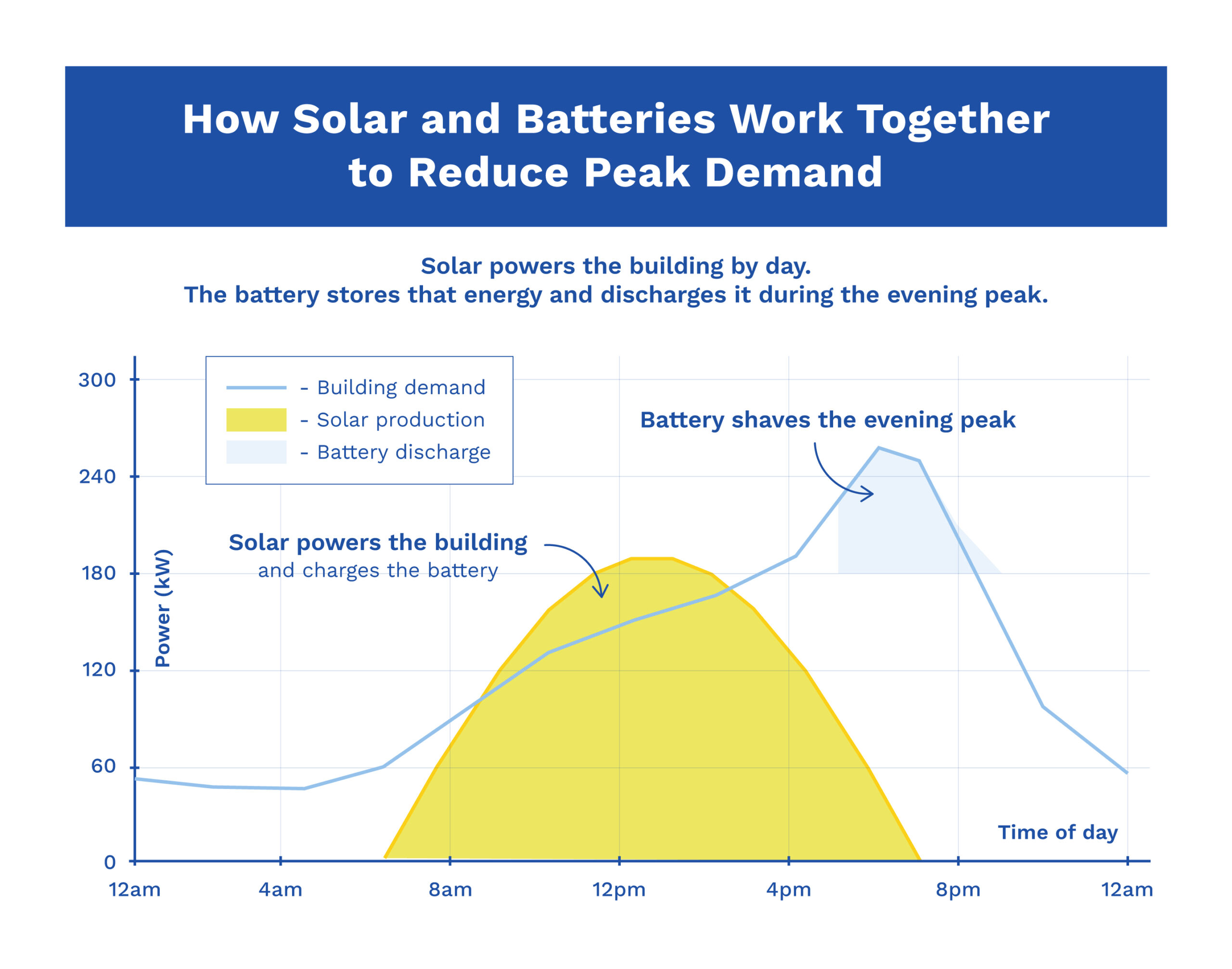
Solar may still substantially reduce the total electricity purchased by these businesses, but it may have a smaller effect on demand charges when the peak occurs after solar production has declined.
Solar can reduce demand charges on its own. The amount simply depends on how consistently the building’s demand and the solar system’s production overlap.
Why Solar and Battery Storage Work Better Together
Solar and battery storage each perform a different job.
Solar produces clean electricity during daylight hours and reduces the amount of energy your business purchases from the utility. Its ability to reduce a specific demand peak depends on the timing of that peak and the solar system’s production at that moment.
A battery stores electricity for later use and can respond when your business approaches a peak, provided it has enough stored energy and available power capacity.
Put them together, and the systems can complement each other:
- Solar produces electricity while the sun is shining.
- Your building immediately uses the solar energy it needs.
- Available excess solar energy can charge the battery.
- The battery stores that electricity for later.
- When your business approaches its demand limit, the battery discharges.
- Your building draws less power from the utility during the critical interval.
- The battery may also provide energy during expensive time-of-use periods.
When solar production falls below the building’s needs, the battery can supplement the available solar energy, as long as it has retained enough charge.
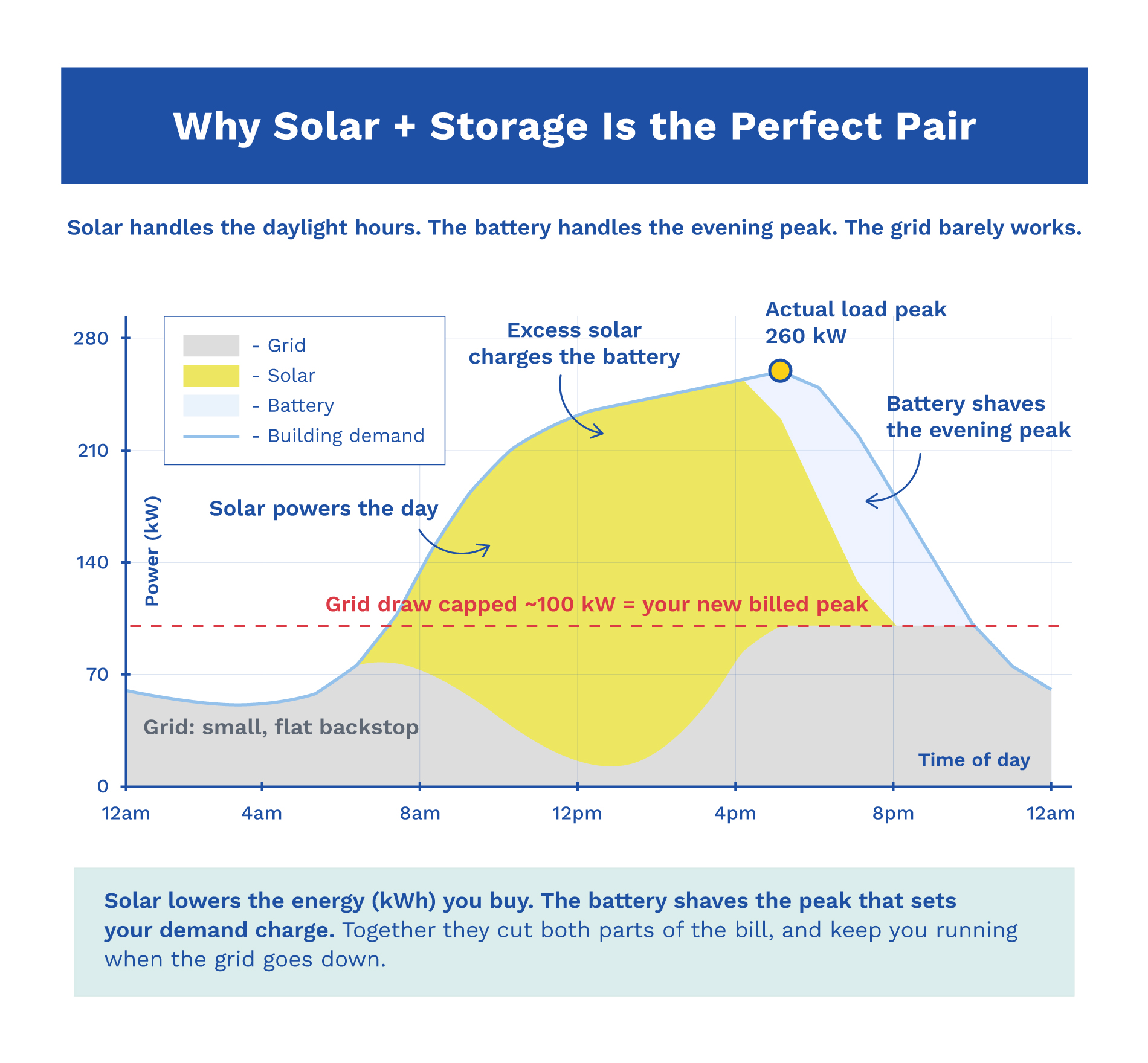
A commercial solar-plus-storage system can address several parts of your electric bill:
- Solar reduces the kilowatt-hours purchased from the utility.
- Battery storage manages the kilowatts drawn during peak periods.
- Solar can provide electricity for charging the battery.
- The battery can extend the usefulness of solar energy beyond daylight hours.
- Both systems can reduce exposure to future utility-rate increases.
- Certain system designs may provide backup power for selected loads during an outage.
For businesses with large electrical loads, high demand rates, and predictable peaks, the long-term savings from solar and storage can reach hundreds of thousands of dollars. Large industrial, manufacturing, refrigeration, data-center, and fleet-charging facilities may have even greater opportunities.
However, the financial value depends on the building’s actual electricity use, rate schedule, system design, incentives, and operating plans. The savings should be calculated using real interval data rather than broad industry assumptions.
Tax Incentives That Can Make Commercial Batteries More Compelling
This is where the numbers often surprise business owners.
As of August 2026, several federal tax incentives may help eligible businesses reduce the net cost of commercial battery storage. The tax rules are detailed and have changed substantially, so every project should be reviewed with a qualified tax professional.
Section 48E Clean Electricity Investment Credit
Qualified commercial battery-storage technology placed in service after December 31, 2024, may be eligible for the federal Section 48E Clean Electricity Investment Credit.
The credit is worth 30 percent of the qualified investment when the project satisfies prevailing-wage and registered-apprenticeship requirements or qualifies for an applicable exception.
Commercial battery storage can qualify on its own. The battery does not necessarily need to be installed with a solar energy system.
This is different from the residential market. The Residential Clean Energy Credit is unavailable for residential clean-energy property placed in service after December 31, 2025.
Five-Year MACRS Depreciation
Qualified energy-storage technology placed in service after December 31, 2024, may be treated as five-year property under the Modified Accelerated Cost Recovery System, commonly called MACRS. This can allow an eligible business to recover the depreciable cost of the battery equipment over a shorter period.
The depreciation treatment of the solar portion of a new solar-plus-storage system may differ from the treatment of the battery. Current IRS instructions state that solar or wind energy property that began construction after December 31, 2024, is no longer included in the former specific five-year solar and wind property category.
A qualified tax professional should determine which components are eligible, the applicable recovery periods, and how the tax credit affects the project’s depreciable basis.
Bonus Depreciation
Current federal law also provides a 100 percent additional first-year depreciation deduction for certain qualified property acquired after January 19, 2025. Eligibility depends on the property, acquisition and placed-in-service dates, ownership structure, and the taxpayer’s individual situation.
This does not necessarily mean that a business can deduct 100 percent of the project’s original purchase price in addition to receiving the full tax credit. The tax credit, depreciable basis, and other deductions interact with each other and should be calculated by the business’s tax advisor.
Energy Community Bonus
Based on Exact Solar’s review of the current federal energy-community maps, the majority of our installation area in Pennsylvania and New Jersey falls within a federally designated energy community as of 2026. This means the energy-community bonus may be available for many of the commercial projects we install.
Eligibility is still determined case by case. The project’s exact address, applicable energy-community category, construction timing, and placed-in-service date must be reviewed before the bonus is included in a financial analysis.
For a Section 48E investment credit, placement within an energy community generally increases the credit by 2 percentage points. The increase can be 10 percentage points when the project also satisfies prevailing-wage and apprenticeship requirements or qualifies for another applicable exception.
For example, a qualifying project that receives the 30 percent credit and qualifies for the full energy-community bonus could potentially receive a 40 percent federal investment credit before considering any other eligible bonus.
Domestic Content Bonus
A qualifying project may also receive a domestic-content bonus when it satisfies federal requirements for U.S.-produced steel, iron, manufactured products, and components.
The domestic-content rules apply to the project as a whole. Choosing a battery marketed as “made in the United States” does not automatically establish eligibility. The taxpayer must satisfy the applicable cost and sourcing rules and submit the required certification.
The bonus can increase the Section 48E investment credit by 2 percentage points. It can increase the credit by 10 percentage points when the project also satisfies prevailing-wage and apprenticeship requirements, has a maximum net output below 1 MW, or meets another applicable exception.
Important 2026 Timing Rules for Commercial Solar
Federal law now includes an accelerated termination date for certain solar and wind projects.
For an applicable solar facility that begins construction after July 4, 2026, the Section 48E credit generally terminates if the facility is placed in service after December 31, 2027.
Because it is now August 2026, the development schedule matters for any business considering a new commercial solar project. Projects beginning now may still qualify when placed in service by December 31, 2027, but permitting, engineering, interconnection, utility approval, equipment availability, and construction timing all need to be considered.
The accelerated wind and solar deadline does not apply to energy-storage technology in the same way, but a combined project should still be reviewed carefully to determine how the rules apply to each component.
Equipment-Sourcing and Prohibited-Foreign-Entity Restrictions
New federal restrictions can also affect Section 48E eligibility for qualified facilities and energy-storage technologies that begin construction after December 31, 2025.
Projects receiving certain levels of material assistance from prohibited foreign entities may be ineligible for the credit. Equipment sourcing can therefore affect more than eligibility for the domestic-content bonus. In some cases, it can affect whether the underlying federal credit is available at all.
These requirements are highly technical and should be reviewed during equipment selection and project contracting, rather than after the system has already been installed.
Credit Transferability and Elective Pay
Section 48E credits may also be eligible for transfer. This may allow an eligible business that cannot efficiently use the entire credit itself to transfer it to another taxpayer, subject to federal rules and registration requirements.
Certain tax-exempt organizations, government entities, and other applicable entities may be able to use elective pay, sometimes called direct pay.
Have Every Incentive Reviewed
Tax rules are always subject to change. Your exact savings depend on your business, project, tax liability, ownership structure, equipment, location, construction timeline, and compliance with federal requirements.
Always confirm the details with your tax advisor before you count on any incentive.
A commercial proposal should clearly separate:
- Gross project cost
- Estimated federal tax credit
- Potential energy-community bonus
- Potential domestic-content bonus
- Depreciation benefits
- Utility or state incentives
- Financing expenses
- Estimated annual utility savings
- Maintenance and operating costs
- Estimated payback period
- Long-term cash flow
Tax incentives should improve the economics of a well-designed project. They should not be used to hide unrealistic assumptions about battery performance, electricity rates, or demand-charge savings.
Next Steps
For many business owners, demand charges have traditionally felt like an unavoidable cost of operating a commercial building. Today, businesses have more options for understanding and managing those charges.
Battery storage can reduce how much power a building draws from the grid during critical periods. Solar can lower the total amount of electricity purchased from the utility. Energy-efficiency improvements, equipment controls, managed charging, and operational changes may also help.
A proper analysis should begin by identifying what is creating the business’s peak.
That review should include:
- At least 12 months of electric bills
- The business’s complete utility rate schedule
- Available 15-minute, 30-minute, or hourly interval data
- Seasonal changes in electricity use
- The timing and duration of demand peaks
- Major equipment loads
- Planned equipment or building expansions
- Future electric vehicle charging
- Available roof, ground, or parking-area space for solar
- Electrical-service limitations
- Utility interconnection requirements
- Backup-power priorities
- Available tax incentives
- Estimated solar and battery performance
- Long-term financial projections
In some buildings, operational changes may help reduce demand. Equipment schedules can sometimes be adjusted so that several large loads do not run simultaneously. HVAC controls, variable-frequency drives, refrigeration controls, managed EV charging, and energy-efficiency improvements may also reduce peaks.
In other buildings, major loads cannot be shifted without interrupting production, affecting customers, or changing essential operations. Those businesses may be stronger candidates for commercial battery storage.
When commercial solar and battery storage are designed around the building’s actual electricity use and rate structure, they can provide meaningful long-term operating savings. However, the system must be sized and modeled specifically for the business.
Exact Solar has designed and installed clean energy systems across Pennsylvania and New Jersey since 2005. We use our own in-house team, not subcontractors.
We would be happy to review your business’s electric bills and provide an honest assessment of whether solar, battery storage, operational changes, or a combination of strategies makes sense for your property.
Schedule a Free Commercial Solar Consultation
Would you like to know how much of your electric bill comes from demand charges?
Schedule a free, no-pressure consultation with Exact Solar. Our commercial solar team can review your utility bills, evaluate your energy-use patterns, and help you understand your options for lowering long-term electricity costs.
Schedule My Free Commercial Solar Consultation
Frequently Asked Questions About Commercial Demand Charges
What kinds of businesses typically have high demand charges?
If you own or manage one of the following types of businesses, demand charges may be a significant part of your electric bill:
- Manufacturing facilities and factories
- Data centers and server rooms
- Hotels and resorts
- Refrigerated and cold-storage warehouses
- Concert and entertainment venues
- Restaurants and commercial kitchens
- Warehouses and distribution centers
- EV-charging stations and fleet depots
- Machine shops and metal-fabrication facilities
- Plastics and injection-molding facilities
- Commercial laundries and laundromats
- Indoor farms, greenhouses, and growing facilities
- Commercial bakeries
- Foundries and metal-casting facilities
- Gyms and fitness centers
- Food and beverage processing facilities
- Schools and institutional buildings
- Hospitals and medical facilities
- Water and wastewater facilities
Operating one of these facilities does not automatically mean battery storage will be financially worthwhile. Your rate schedule, demand profile, and interval data still need to be reviewed.
What is a demand charge in simple terms?
A demand charge is a fee based on the highest average rate at which your business draws power from the electric grid during a defined measurement interval. It is measured in kilowatts, or kW.
It is separate from the energy charge, which is based on your total energy use in kilowatt-hours, or kWh.
Why does my business have a demand charge but my home does not?
Most homes are billed primarily based on their total electricity consumption.
Businesses can draw much larger amounts of power at one time. Utilities use demand charges to recover some of the cost of maintaining the generation, transmission, distribution, and local equipment needed to serve those larger loads.
Not every commercial account includes a demand charge, and certain residential or specialized utility rates may also include demand-based pricing. The structure depends on the utility company and rate schedule.
How do I find the demand charge on my bill?
Look for a line containing terms such as:
- Demand
- Billing demand
- Maximum demand
- Peak demand
- On-peak demand
- Capacity
- Distribution demand
- Transmission demand
Demand is generally listed in kW rather than kWh.
Your bill may show the measured demand, the billing demand, the rate per kW, and the resulting charge. Some tariffs include more than one demand-related line, so adding only one line may not show the full demand-related cost.
How much of my bill is the demand charge?
For many businesses Exact Solar has worked with, demand-related charges represent approximately 30 to 70 percent of the total electric bill.
The exact percentage depends on:
- Your utility company
- Your rate class
- Your highest measured demand
- Your total energy consumption
- The duration and timing of your peaks
- Seasonal rates
- Demand ratchets
- Capacity and transmission charges
- Other tariff rules
One bill may not represent the full picture. A complete review should generally include at least 12 months of utility bills.
Will solar panels lower my demand charge without batteries?
Sometimes, but not always predictably.
Going solar lowers the total amount of energy your business purchases from the utility. It can also reduce demand when strong solar production occurs during the same interval in which your business would otherwise establish its peak.
If your business consistently peaks during sunny daytime hours, solar may provide meaningful demand savings. If the peak happens after sunset, late in the afternoon, or during low solar production, the effect may be smaller.
Demand savings from solar alone should be based on the business’s actual interval data and modeled conservatively.
How does a battery lower my demand charge?
Batteries can be programmed to respond when your building’s grid demand begins approaching a defined limit.
The battery supplies part of the building’s electricity, reducing the amount of power drawn through the utility meter. Your equipment continues operating, but the meter records a lower grid-demand level during the critical interval.
The amount saved depends on the battery’s size, programming, available charge, the duration of the peak, and the utility’s rate rules.
Do I need solar to get a battery, or can a battery work alone?
A battery can reduce demand charges without solar.
A standalone battery may charge from the grid during lower-cost or lower-demand periods and discharge when the building approaches a peak.
Pairing it with solar can add value because solar can:
- Reduce total utility electricity purchases
- Provide electricity for charging the battery
- Allow more onsite solar production to be used
- Reduce exposure to time-of-use energy rates
- Support the building’s load during sunny peak periods
As of August 2026, qualified business battery storage may be eligible for the Section 48E investment credit even when it is installed without solar.
How big a battery do I need?
It depends on how high your peaks are and how long they last.
A battery used for demand-charge reduction is sized according to both:
- Power in kW: How much of the peak it can reduce at one time
- Energy in kWh: How long it can continue reducing the peak
A battery with insufficient power may not reduce the peak enough. A battery with insufficient energy may reach its minimum charge before the peak period ends.
The design should account for:
- Historical interval data
- Peak height and duration
- Multiple daily peaks
- Battery efficiency
- Usable capacity
- Battery degradation
- Solar production
- Rate-schedule rules
- Future business growth
- Backup-power requirements
The best way to size a battery for a commercial building is to study the business’s actual utility bills and interval data.
Can a battery completely eliminate demand charges?
Usually, the goal is to reduce demand charges rather than assume they can be completely eliminated.
The battery would need to cover every relevant peak for the required interval and maintain enough energy for unexpected loads, multiple peaks, changes in operating schedules, and seasonal conditions.
Some utility rates also include minimum demand, contract demand, demand ratchets, transmission charges, capacity charges, or other costs that cannot be completely eliminated through battery discharge.
A commercial proposal should clearly identify which charges are expected to decrease and which will remain.
How much does a commercial battery cost, and what is the payback period?
Commercial battery systems are custom-designed, so a broad price range may be misleading. The cost and payback period depend on:
- Required battery power in kW
- Required energy capacity in kWh
- Equipment and control systems
- Electrical upgrades
- Site work
- Fire-code and safety requirements
- Interconnection requirements
- The business’s demand rate
- Peak frequency and duration
- Available incentives
- Financing structure
- Whether the battery is paired with solar
- Whether backup power is included
A facility with high demand rates and predictable recurring peaks may have a strong financial opportunity. A business with low demand charges, an unfavorable rate structure, or irregular peaks may not.
Exact Solar can review your business’s electricity use and prepare a project-specific estimate based on your building.
What tax breaks are available for commercial-scale batteries?
As of August 2026, qualified commercial battery storage may be eligible for:
- The Section 48E Clean Electricity Investment Credit
- A 30 percent credit when applicable labor requirements or exceptions are satisfied
- Five-year MACRS treatment for qualifying energy-storage technology
- Potential 100 percent bonus depreciation for eligible property
- An energy-community bonus of 2 or 10 percentage points
- A domestic-content bonus of 2 or 10 percentage points
- Credit-transfer options for qualifying taxpayers
- Elective pay for certain tax-exempt and governmental entities
Exact Solar has verified that the majority of our Pennsylvania and New Jersey installation area falls within designated energy communities as of 2026. However, eligibility must still be confirmed for the exact project location and circumstances.
Tax rules change and depend on your business, project, and tax situation. Always confirm the details with a qualified tax advisor before including tax benefits in your financial projections.
What information does Exact Solar need to evaluate my business?
A useful initial review generally requires at least 12 months of electric bills. Interval data is even more valuable because it shows exactly when your business’s highest demand occurs and how long the peaks last.
We may also ask about:
- Your operating schedule
- Major equipment
- Planned building or production changes
- Future EV charging
- Backup-power priorities
- Available roof, ground, or parking space
- Your goals for savings, resilience, and long-term energy costs
We use this information to explain what is driving your bill and whether solar, battery storage, or another demand-management strategy is likely to make sense.