
When a community decides to invest in clean energy, it sends a message that they care about the future. When they invest in clean energy while rebuilding after a disaster, it tells the world they’re coming back stronger than ever.
Upper Dublin Township began rebuilding its municipal campus after the devastating tornado caused by Hurricane Ida in 2021. Starting from scratch, the Township had a unique opportunity to do much more than replace what had been lost. They could instead build a modern facility designed to serve the community for decades to come.
As part of that vision, Upper Dublin incorporated a commercial solar energy system into its new Township and Police Building and Public Works facility. The result is a 519.2 kW DC solar photovoltaic (PV) system that will generate clean electricity for decades while helping reduce long-term operating costs for taxpayers.
Exact Solar was proud to serve as the commercial solar contractor for this project, designing and installing a system tailored to the unique needs of a modern municipal campus.
Projects like this demonstrate how commercial solar can help municipalities invest in resilient infrastructure, manage rising energy costs, and lead by example for the communities they serve.
Table of Contents
Rebuilding Stronger After Hurricane Ida
In September 2021, the remnants of Hurricane Ida brought severe weather across southeastern Pennsylvania. One tornado caused extensive damage to Upper Dublin Township’s municipal facility, ultimately leading to the construction of a brand new Township and Police Building, along with an addition to the Public Works facility.
Rather than simply replacing what had been lost, the Township took the opportunity to invest in infrastructure that would better serve residents well into the future.
Incorporating solar into the project was a natural fit. By generating electricity on-site, the Township can offset a significant portion of its energy usage while protecting itself against rising utility costs for years to come.
The completed facility now serves residents from a modern, energy-efficient campus powered in part by the sun.
Why More Municipalities Are Choosing Solar
Across Pennsylvania and New Jersey, municipalities are increasingly exploring commercial solar to reduce operating expenses without sacrificing services.
Unlike many building improvements that simply add costs, solar produces electricity that offsets energy purchased from the utility. Over the life of the system, those savings can be redirected toward other community priorities.
Commercial solar can also help municipalities:
- Lower long-term electricity costs
- Create more predictable operating budgets
- Demonstrate environmental leadership
- Reduce greenhouse gas emissions
- Improve the sustainability of public facilities
- Take advantage of available federal incentives and funding opportunities
For communities planning new construction or major renovations, incorporating solar during the design phase is often more efficient than adding it later.
Upper Dublin Township recognized that opportunity and made solar part of its long-term vision for the new municipal campus.
Project Overview
This installation is among the largest municipal solar projects in our region.
Project Specifications
- System Size: 519.2 kW DC
- Location: Upper Dublin Township, Montgomery County, Pennsylvania
- Facilities Served: Township and Police Building and Public Works Facility
- Solar Panels: 944
- Commercial Inverters: 10
- Rapid Shutdown Devices: 378
- Installation Areas:
- Multiple sloped roof sections
- Flat roof areas
- Solar carport canopy over a portion of the parking lot
Rather than concentrating the entire system on a single roof, the design uses multiple building surfaces and a solar parking canopy to maximize available space and energy production.
Every kilowatt-hour generated by the system is consumed on-site, helping power the offices, police facilities, and public works operations that serve Upper Dublin residents every day.
Engineering a Complex Commercial Solar System
Commercial solar projects rarely involve a single, unobstructed roof.
Large facilities often include multiple roof elevations, varying roof pitches, rooftop mechanical equipment, parapets, access pathways, and structural considerations that all influence system design. This project was no exception.
Each roof section had distinct characteristics, requiring individual engineering analysis before being integrated into a coordinated commercial solar system.
“Each solar energy system on each surface was modeled separately for orientation, tilt, and shading before being integrated into one coordinated system with unified production estimates.”
– Stanislav Kvochak, Exact Solar Project Engineer
Because different portions of the array receive sunlight at different times throughout the day, careful production modeling was essential to optimize performance across the entire campus.
This detailed engineering process helps ensure the system performs as expected over its lifetime while making the best possible use of every available square foot of rooftop space.
Projects like this are a great example of why commercial solar engineering involves far more than simply placing panels wherever they fit.
Making the Most of Every Available Surface
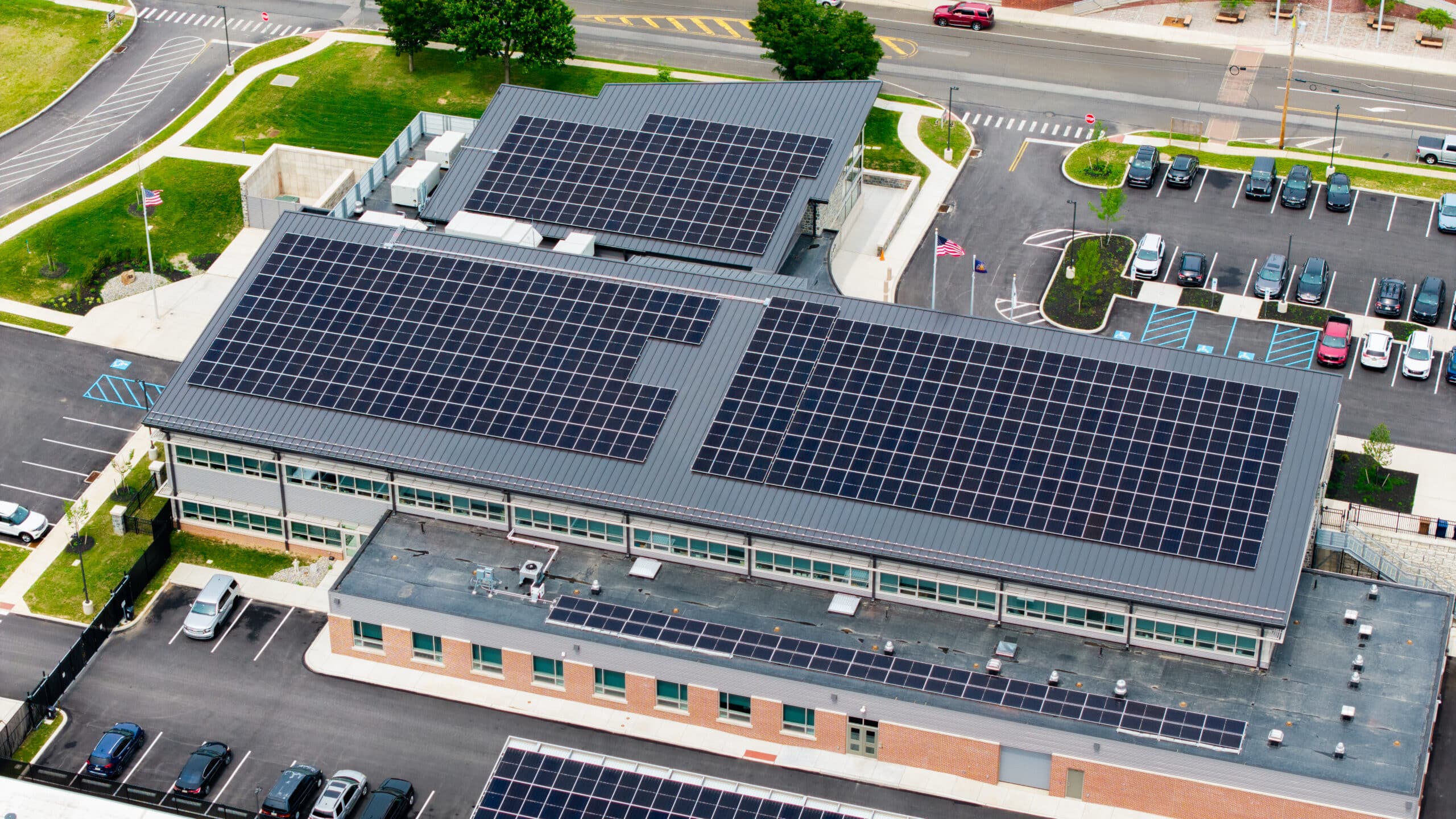
One of the most interesting aspects of this project is how many different installation areas were incorporated into the overall design.
Instead of relying on a single roof, the solar arrays were distributed across traditional sloped roof sections, flat roof areas, and a dedicated solar carport structure.
This approach allowed the Township to maximize solar production while working within the architectural design of the new campus.
For commercial facilities, every building presents unique opportunities and constraints. An experienced design team evaluates each usable surface independently before determining how they can work together as one integrated system.
The Benefits of Solar Carports
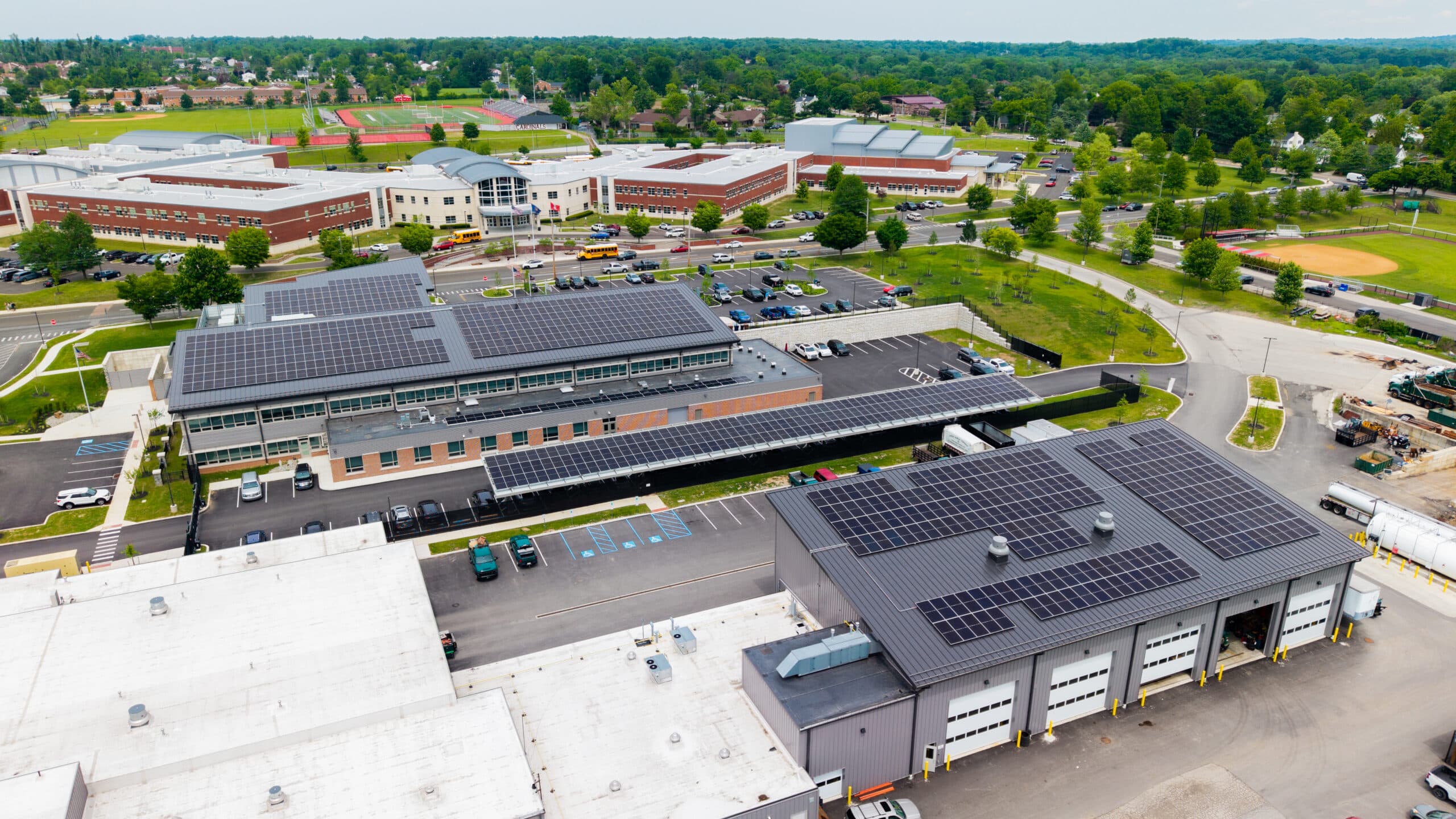
The solar carport installed at Upper Dublin deserves special attention.
Solar carports are becoming increasingly popular for commercial properties because they transform existing parking areas into productive assets.
Instead of allowing a parking lot to simply absorb heat throughout the day, a solar canopy generates electricity while providing additional benefits for employees and visitors.
Solar carports can:
- Generate clean electricity without using additional land
- Provide shade during hot summer months
- Protect vehicles from rain and snow
- Improve the appearance of parking facilities
- Create opportunities for future EV charging infrastructure
For municipalities, businesses, schools, and other organizations with large parking areas, solar carports can significantly expand available solar capacity when rooftop space is limited.
Why Experience Matters on Municipal Solar Projects
Municipal construction projects involve significantly more coordination than many traditional commercial installations.
In addition to designing an efficient solar system, contractors often work alongside architects, structural engineers, electrical engineers, construction managers, inspectors, utility companies, and multiple government stakeholders throughout the project.
These projects may also include:
- Prevailing wage requirements
- Public bidding processes
- Security clearances
- Multiple permitting agencies
- Layered inspections
- Strict construction schedules
Solar is only one component of a much larger construction project, and coordination is critical. Exact Solar worked closely with the project team throughout design and construction to ensure the solar installation integrated smoothly with the broader municipal campus while staying aligned with the overall construction schedule.
As a turnkey commercial solar contractor, Exact Solar manages every phase of the solar process, including design, engineering, permitting, utility interconnection, procurement, installation, commissioning, and long-term service.
That integrated approach helps simplify complex commercial projects and provides a single point of accountability from start to finish.
Environmental and Financial Impact
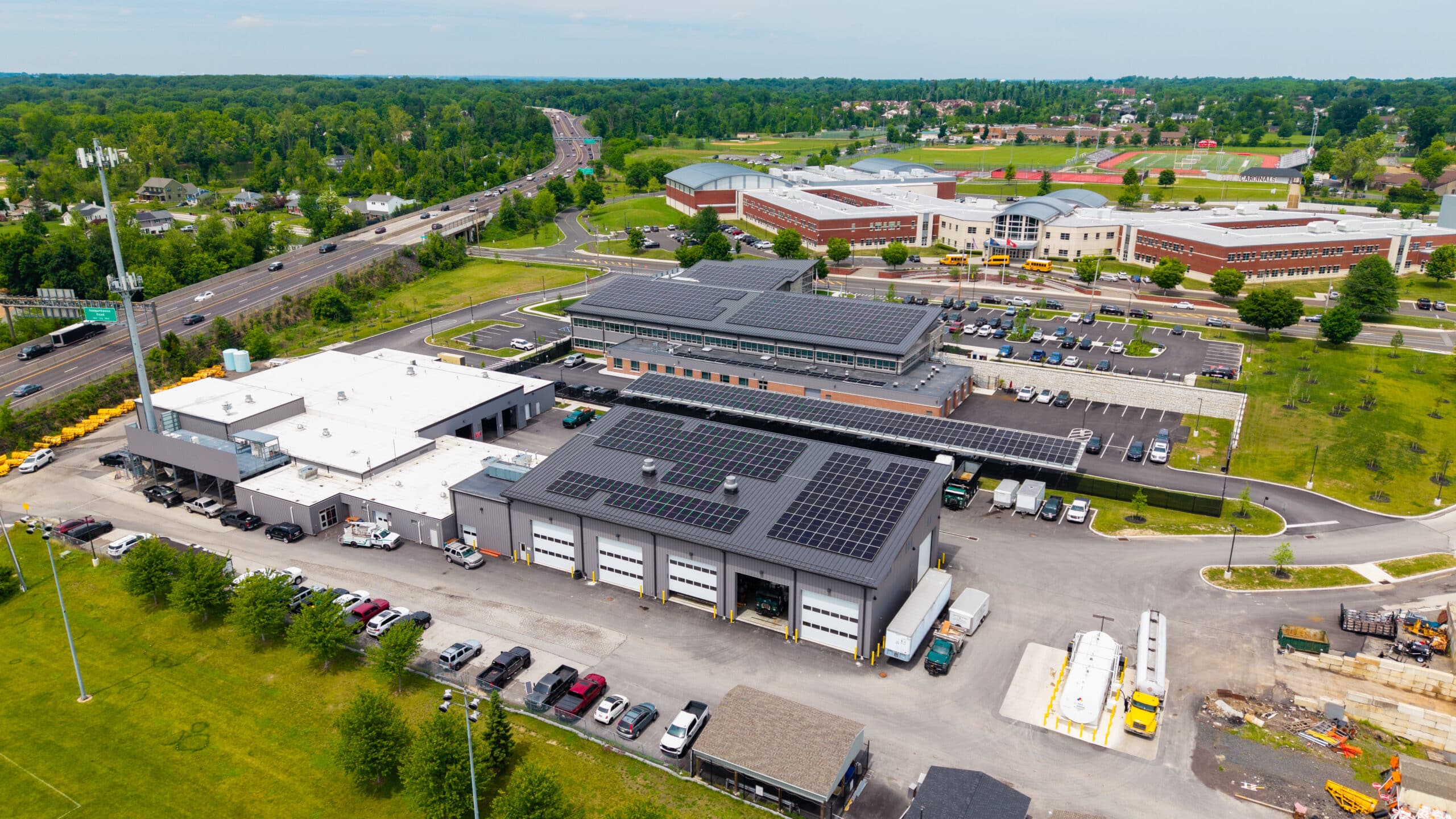
This commercial solar installation is expected to generate approximately 611,000 kilowatt-hours of clean electricity every year.
Over the coming decades, that production will help reduce electricity purchased from the utility while providing meaningful environmental benefits.
Estimated annual impact includes:
- Approximately 611,000 kWh of clean electricity generated each year
- Enough electricity to power roughly 58 average homes
- Approximately 433 metric tons of carbon dioxide emissions avoided annually
- Equivalent to removing about 94 gasoline-powered vehicles from the road each year
- Comparable to the annual carbon absorption of approximately 210 acres of forest
Over a 25-year period, the system is expected to avoid nearly 10,000 metric tons of carbon dioxide emissions, equivalent to planting roughly 166,000 trees and allowing them to grow for ten years.
These figures are engineering estimates based on expected system production and regional solar conditions. Environmental equivalencies are calculated using standard U.S. EPA conversion factors.
Commercial Solar for Municipalities and Businesses
Every commercial building is different, but the goals are often the same: lower operating costs, improve long-term budget predictability, increase sustainability, and make better use of existing facilities.
Whether you’re planning a municipal building, office, warehouse, manufacturing facility, nonprofit campus, school, or public works building, commercial solar can often become an important part of your long-term energy strategy.
The earlier solar is considered in a construction project, the more opportunities there are to optimize the building’s design for future energy production.
Commercial solar projects are rarely one-size-fits-all. Every property has its own energy usage, building layout, structural considerations, and financial goals. That’s why every commercial project begins with a feasibility review and detailed engineering analysis.
At Exact Solar, our commercial team works with municipalities, businesses, nonprofits, schools, and other organizations throughout Pennsylvania and New Jersey to evaluate opportunities for commercial solar installations.
Whether you’re planning new construction, renovating an existing facility, or simply exploring your options, we’re happy to help you understand what’s possible.
Connect With Our Commercial Team
This project was led by Joe Tarzia, one of Exact Solar’s Commercial Sales Engineers. Joe works with municipalities, businesses, nonprofits, and other organizations to evaluate commercial solar opportunities, develop customized system designs, and guide projects from initial feasibility through installation.
If you’d like to discuss your project or explore whether commercial solar is a good fit for your facility, Joe would be happy to help.

Joe Tarzia
Commercial Sales Engineer
📞 (267) 623-6729
✉️ [email protected]
Frequently Asked Questions About Commercial Solar
Is my building a good fit for commercial solar?
Many commercial buildings are excellent candidates for solar because they typically have large roof areas and significant daytime electricity usage. During an initial feasibility review, we’ll evaluate your roof, electrical infrastructure, energy usage, and site conditions to determine whether solar is a good fit.
Can solar be incorporated into new construction?
Yes. In fact, new construction is often the ideal time to plan for solar. Early coordination allows the building, electrical systems, structural design, and roof layout to be optimized before construction is complete.
What if my building has multiple roof sections?
That’s common.
Commercial solar systems are frequently designed across multiple roof elevations, orientations, and building sections. Each area is modeled independently before being combined into one integrated system, just as we did for Upper Dublin Township.
Can a parking lot be used for solar?
Absolutely.
Solar carports allow organizations to generate electricity above existing parking areas while providing shade and weather protection for vehicles. They can also support future electric vehicle charging infrastructure.
How long does a commercial solar project take?
Every project is different, but most commercial installations move through several phases:
- Site evaluation
- Engineering and system design
- Permitting
- Utility interconnection
- Equipment procurement
- Installation
- Inspection and commissioning
Exact Solar manages the entire process and coordinates with all project stakeholders from start to finish.
What does “turnkey” mean?
A turnkey commercial solar contractor manages every stage of the project, including design, engineering, permitting, utility coordination, procurement, installation, commissioning, and ongoing service.
Instead of coordinating multiple vendors, you’ll work with one experienced team throughout the project.
How do we get started?
The first step is simply a conversation.
We’ll discuss your facility, review your energy usage and project goals, evaluate your site, and help determine whether commercial solar is the right fit for your organization.
Every project starts with understanding your needs and designing a system that makes sense for your building.